

SlideServe
Menu
Préférences
© SlideServe · v2026

Participial Phrases

rooney-holmes avatar
15 diapositives · 842 Views · Nov 16, 2014

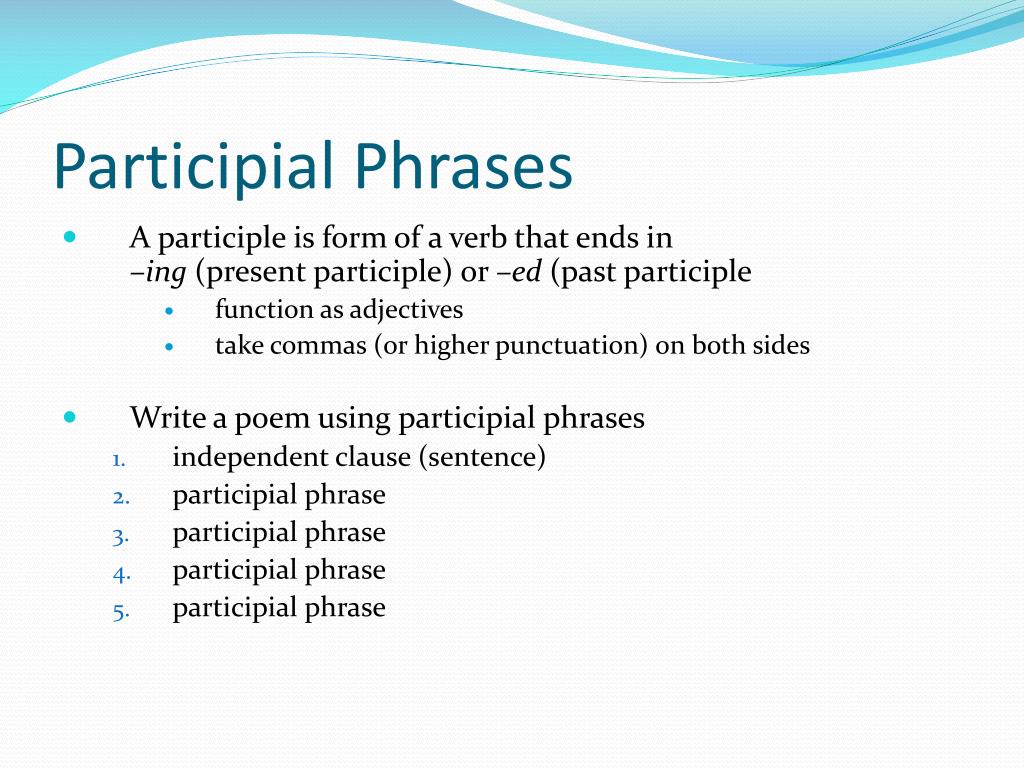
Participial Phrases. A participle is form of a verb that ends in –ing (present participle) or –ed (past participle function as adjectives take commas (or higher punctuation) on both sides Write a poem using participial phrases independent clause (sentence) participial phrase
Participial Phrases - slide 1
01 / 15Participial Phrases
1 / 17

Télécharger la présentation

Participial Phrases
Une image / un lien ci-dessous est fourni (tel quel) pour télécharger la présentation

Politique de téléchargement : le contenu du site vous est fourni TEL QUEL pour votre information et votre usage personnel ; il ne peut être vendu, concédé sous licence ni partagé sur d’autres sites sans l’accord de son auteur.Le contenu vous est fourni TEL QUEL, pour votre information et votre usage personnel uniquement. Téléchargez la présentation en cliquant sur ce lien. Lors du téléchargement, si vous ne parvenez pas à télécharger une présentation, l’éditeur a peut-être supprimé le fichier de son serveur.Pendant le téléchargement, si vous ne parvenez pas à obtenir une présentation, le fichier a peut-être été supprimé par l’éditeur.

F I N

Plus de contenu associé

Transcription de la présentation
  1. Participial Phrases • A participle is form of a verb that ends in –ing (present participle) or –ed (past participle • function as adjectives • take commas (or higher punctuation) on both sides • Write a poem using participial phrases • independent clause (sentence) • participial phrase • participial phrase • participial phrase • participial phrase

  2. What is RHETORIC and why do we study it? Persuasion: using language to make others do what you want. IMPORTANCE: When we study rhetoric, it helps us notice the persuasive techniques being directed at us as we read, hear, and view text and other media every day in and outside of school. It also helps us craft our own persuasive writing.

  3. Rhetorical Triangle #1: Situation Speaker • Occasion • Setting • Purpose Audience Purpose

  4. What is a rhetorical strategy? • A way of using language that is designed to influence an audience’s thoughts about an issue. • We will study three major rhetorical strategies: • logos • pathos • ethos

  5. Rhetorical Triangle #2: Strategies Logos Pathos Ethos

  6. Logos-appealing to the audience’s sense of logic or intelligence. • The Author’s Central Claim (Thesis) • Explanation: Reasons the thesis is true • Requirement / Action • ___ is required in order to ___ • Object/ion • ___ is used for ___

  7. Evidence • Evidence that the reasons are true • Logical Examples • Empirical-acquired by observation or experimentation (facts/data, numbers/statistics, history) • Anecdotal-relates a brief story • Expert Opinions • Personal Experience • Opposites • ___ is the opposite of ___ • Defining Characteristic • ___ can be described as ___

  8. Counterarguments • Counterarguments acknowledge opposing views • State the counterargument fairly • refute (explain why it’s wrong) –OR- • concede (acknowledge that it’s right and explain why it doesn’t matter)

  9. Infoshots (Evidence) Cause/Effect: ________ can cause ________. Transformation: _________ transforms into ________. Item/Category: _________ is a type of _________. Defining Characteristic: ________ can be described as ________. User/Tool: __________ uses __________. Part/Whole: __________ is a part of a __________. Opposites: _________ is the opposite of __________. Synonyms: ________ is almost the same as _________.

  10. Structure #1-LOGOS 1. Here is my view (Thesis) 2. Logical Reason/Evidence/Infoshot #1 3. Logical Reason/Evidence/Infoshot #2 4. Logical Reason/Evidence/Infoshot #3 5. Counterargument 5. Therefore….

  11. Pathos-Appealing to the audience’s sense of emotion using descriptive language. • Emotional connotations with diction • personal anecdotes (stories) • imagery (vivid descriptions) • figurative language • tone (humor, sarcasm, disappointment, excitement, etc.) • BEWARE OF: Propaganda-an argument that appeals ONLY to the emotions is by definition WEAK. Although sometimes pathos alone can be powerfully persuasive, propaganda is generally considered to be an empty tactic, as it manipulates, rather than appeals to, the audience’s emotions.

  12. Ethos - the speaker’s credibility and character 1. Speaker’s profession and/or background-valid qualifications (expertise, knowledge, experience, training) 2. Appropriate vocabulary, correct grammar 3. Evidence of shared values between speaker and audience 4. Speaker is morally/ethically likeable 5. Appropriate tone of the text-makes a good impression 6. Thoroughness of information

  13. Application Time Scenario: You’re a senior in high school and your curfew is still set for midnight. All of your other friends don’t have to be home until 2am. Your purpose is to persuade your mom to extend your curfew. -Write down 2 reasons with evidence that will convince your mother why you deserve a later curfew. Focus on incorporating statements that reflect all 3 appeals-logos, pathos, and ethos. How can you appeal to your mother’s emotions? How can you remind her of your character and your credibility? Be ready to share your argument with the class.