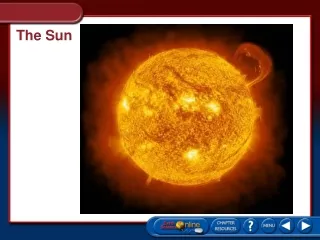
Understanding the Structure and Dynamics of the Sun: Core to Corona
This document provides a comprehensive overview of the properties and main regions of the Sun, including the core, radiative zone, convective zone, photosphere, chromosphere, and corona. It details energy generation processes, temperature variations, and the characteristics of the solar wind and coronal mass ejections. Key features like sunspots, solar flares, and prominences are also discussed, shedding light on their impact on solar cycles and Earth's environment. This insightful exploration of solar physics aims to enhance understanding of our closest star.


Understanding the Structure and Dynamics of the Sun: Core to Corona
E N D
Presentation Transcript
Nada Al-Haddad KU Leuven THE SUN SHINE 2011 1
OUTLINES • Properties • Core • Radiative Zone • Convective Zone • Photosphere • Chromosphere • Corona 2
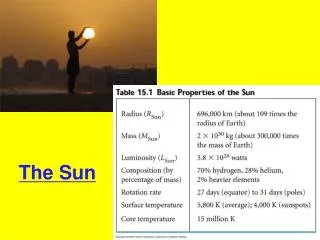
Properties • Main Sequence G star • M⨀= 2x1030 kg • R⨀ = 7x10⁸ m = 7x10⁵ km • L⨀ = 3.9x1026 W (Solar Constant = 1350 W/m2) • Mean Density = Mass/Volume = M/((4/3)πR3)= 1400 kg/m3 = 1.4 g/cm3 3
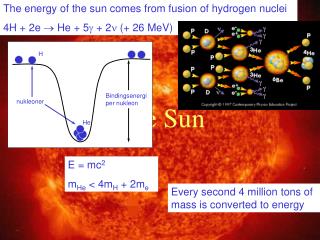
Main Regions The core Energy generation through nuclear burning 5
Main Regions The core Energy generation through nuclear burning Adapted from George Rafflet at Jigsaw, India 2007 6
Main Regions Radiative Zone Energy transportation through Radiation 7
Main Regions Convective Zone Energy transportation through Convection 8
Main Regions Convective Zone Energy generation through nuclear burning 9
Photosphere • Source of Photons • 6000 K Features: • SUNSPOTS • Low temperature in the photosphere ~ 4780 K • Intense magnetic field • Days-Weeks 10
Chromosphere • 1600 Km • 10^-4 the intensity of the photosphere • Temperature increase 4400-100000 K • He II, Fe II, Si II, Cr II and Ca II Features: • Flares • Prominences 11
Corona 5273 K • Very high temperature • Visible at total eclipse • No well defined outer boundary • Low density Features: 2,000,273 K • Coronal holes • Dark in X-ray and EUV • Low density • High speed Solar wind 13
Solar wind • Constant stream of charged particles (Plasma) from Sun to beyond pluto ( 5900 million km) • 95% protons & electrons, 5% isotopes: helium-3, helium-4, neon-20, neon-21, neon-22, and argon-36 • Average speed 450 km/s • Average Density4 atoms/cm3 • Shapes the magnetosphere 14
Solar wind • Constant stream of charged particles (Plasma) from Sun to beyond pluto ( 5900 million km) • 95% protons & electrons, 5% isotopes: helium-3, helium-4, neon-20, neon-21, neon-22, and argon-36 • Average speed 450 km/s • Average Density4 atoms/cm3 • Shapes the magnetosphere 15
Solar Cycle 16
Solar Cycle 17
Coronal Mass Ejections • explosions in the Sun's corona • huge bubbles of gas threaded with magnetic field lines • 10^6 K • A lot of material is thrown out into the solar wind • CME's can seriously disrupt the Earth's environment 18
Dank U Wel! 19