Download
1 / 12
130 likes | 266 Vues
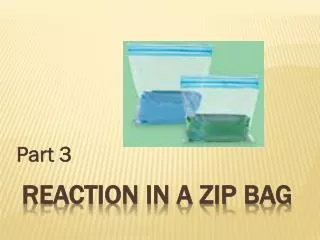
This lab activity allows students to investigate a chemical reaction by mixing baking soda (NaHCO3) and calcium chloride (CaCl2) to illustrate the Law of Conservation of Matter. Students will analyze the mass before and after the reaction, ensuring the bag is sealed to prevent gas escape. Through this experiment, they will understand that matter is neither created nor destroyed in a chemical reaction. The activity includes data collection, reflection exercises, and additional tests to reinforce these concepts using safe chemical practices.

E N D
Objective • The student will be able to analyze a chemical reaction in order to explain the law of conservation of matter.
Recall the Law of Conservation of Matter (or Mass) • The Law of Conservation of Matter states that during a chemical reaction, matter is neither created nor destroyed. • In other words, the total amount of matter before and after a chemical reaction stays the same.
SILENTLY read the procedure. • What is the purpose of this lab? • Why is it necessary to make sure the bag is sealed tightly? • In step I, it says to mass the rubber band with the bag, why?
Today we will be doing the following chemical reaction: • 2NaHCO3 + CaCl2 -----> CaCO3 + 2NaCl + H2O + CO2
Answer the following question on page 21: • Based on what the Law of Conservation of Matter states, what do you think will happen to the mass after the chemical reaction between baking soda and calcium chloride occurs? (Will it increase, decrease or stay the same?) Explain your answer.
On Page 22 of your notebook, draw the following chart and title it “Reaction in a Bag Data”
Clean-up Procedure • Give the Ziploc bag to Mr. Hong. • Make sure your station is neat and clean. • Stack the goggles. • Take your seat.
Read • Conserving the Matter • Complete “Life in a Jar Reflections 3”
Paste the “Reaction in a Bag analysis” on page 21. • Paste the reading “Conserving Matter” on page 20 • Paste “Life in a Jar Reflections 3” on page 23
Can you do an experiment with seltzer tablet and water to test the Law of conservation of matter? • How will you keep the tablet from reacting with the water before you are ready? • Does it matter how much water that you use?