
Human Inheritance
E N D
Presentation Transcript
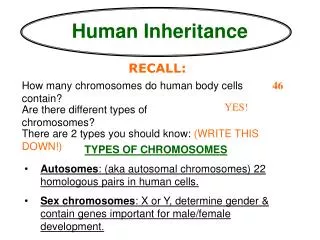
Human Inheritance Chapter 4 Section 1
You Have Your Mother’s Eyes • Have you ever heard someone say “He’s the spitting image of his dad” or “She has her mother’s eyes”? • Children often resemble their parents. The reason for this is that alleles for eye color, hair color, and thousands of other traits are passed from parents to their children. • People inherit some alleles from their mother and some from their father. • This is why most people look a little like their mother and a little like their father.
Traits Controlled By Single Genes Many human traits are also controlled a single gene with one dominant allele and one recessive allele. • As with tall and short pea plants, these human traits have two distinctly different phenotypes, or physical appearances. • For example, a widow’s peak is a hairline that comes to a point in the middle of the forehead. • The allele for a widow’s peak is dominant over the allele for a straight hairline.
Multiple Alleles • Some human traits are controlled by a single gene that has more than two alleles. • Such a gene is said to have multiple alleles – three or more forms of a gene that code for a single trait. • You can think of multiple alleles as being like flavors of pudding. • Pudding usually comes in more flavors than just chocolate and vanilla!
Multiple Alleles cont. • Even though a gene may have multiple alleles, a person can carry only two of those alleles. • This is because chromosomes exist in pairs. • One human trait that is controlled by a gene with multiple alleles is blood type.
Blood Types • There are four main blood types – A, B, AB, and O. • Three alleles control the inheritance of blood types. • The allele for blood type A and the allele for blood type B are codominant. • The codominant alleles are written as capital letters with superscripts – IA for blood type A, and IB for blood type B. • The allele for blood type O is recessive and written like i. • A person who inherits an allele for both A blood type and B blood type are codominant. Neither allele is masked and results in blood type AB.
Traits Controlled by Many Genes • Some human traits show a large number of phenotypes because the traits are controlled by many genes. • The genes act together as a group to produce a single trait. • At least four genescontrol height in humans, so there are many possible combinations of genes and alleles.
Skin Color • Like height, skin color is determined by many genes. • Human skin color ranges from almost white to nearly black, with many shades in between. • Skin color is controlled by at least three genes. • Each gene, in turn, has at least two possible alleles. • Various combinations of alleles at each of the genes determine the amount of pigment that a person’s skin cells produce. • Thus, a wide variety of skin color is possible
The Effect of Environment • The effects of genes are often altered by the environment – the organism’s surroundings. • For example, people’s diets can affect their height. A diet lacking in protein, minerals, and vitamins can prevent a person from growing to his or her potential maximum height. • Since the late 1800’s, the average height of adults in the United States has increased by almost 10 centimeters. • During that time, American diets have become more healthful. • Other factors, such as medical care and living conditions, have also improved since the 1800s.
Male or Female • Factors that determine whether a baby is a boy and a girl are determined by genes on chromosomes. • Among the 23 pairs of chromosomes in each body cell is a single pair of chromosomes called sex chromosomes. • The sex chromosomes determine whether the baby is a male or female.
Sex Chromosomes • The sex chromosomes are the only pair of chromosomes that do not always match. • If you are a female, your two sex chromosomes match. • The two chromosomes are called X chromosomes. • If you are a male, your sex chromosomes do not match. • One of your sex chromosomes is a Y chromosome. • The Y chromosome is much smaller than the X chromosome.
50 – 50 Chance • Since both the female’s sex chromosomes are X chromosomes, all eggs carry one X chromsome. • Males, however, have two different sex chromosomes. This means that half of a male’s sperm cells carry and X chromosome, while half carry a Y chromosome. • When a sperm cell with an X chromosome fertilizes an egg, the egg will have two X chromosomes which will result in a girl. • When a sperm cell with a Y chromosome fertilizes an egg, the egg will have one X chromosome and one Y chromosome resulting in a boy. • *The sperm determines the sex of the child.
Punnett Square • Father XY • X Y Mother XX X X
Sex-Linked Genes • Some human traits occur more often in one sex than the other. • The genes for those traits are often carried on the sex chromosomes. • Genes on the X and Y chromosomes are often called sex-linked genes because their alleles are passed from parent to child on a sex chromosome. • Traits controlled by sex-linked genes are called sex-linked traits.
Dominant and Recessive Alleles • Sex-linked genes can have dominant and recessive alleles. • Females have two X chromosomes, and males have one X and one Y chromosome. • In females, a dominant allele on one X chromosome will mask the recessive allele on the other X chromosome. • This is not the same for males. • In males, there is not matching alleles on the Y chromosome to mask the allele on the X chromosome. • As a result, any allele on the X chromosome, even a recessive allele, will produce the trait in a male who inherits it. • Because males only have one X chromosome, they are more likely than females to have a sex-linked trait that is controlled by a recessive allele.
Examples • An example of a sex-linked trait that is controlled by a recessive allele is red-green colorblindness. • A person with red-green colorblindness can not distinguish between red and green. • Many more males than females have red-green colorblindness. • If you look at page 117, you can see a Punnett square for this trait. • Notice that the mother is a carrier. • A carrier is a person who has one recessive allele for a trait and dominant allele. • The carrier does not have the trait, but can pass the recessive allele on to his or her offspring. • In the case of sex-linked traits, females can only be carriers.
Pedigree • One important tool that geneticists use to trace the inheritance of traits in humans is a pedigree tree. • A pedigree is a chart or “family tree” that tracks which members of a family have a particular trait. • The trait recorded in a pedigree can be an ordinary trait such as widow’s peak, or it can be a sex-linked trait such as colorblindness. • Look on page 118, to see how colorblindness is traced through a family