Understanding Linear Motion Equations: Displacement and Frame of Reference
This guide by Jessica Hall provides a comprehensive overview of the equations governing linear motion. It covers essential concepts such as displacement (∆x), time of travel (∆t), acceleration (a), and both initial (vi) and final velocity (vf). Key equations include Vf = Vi + at, ∆x = (Vi + Vf)t/2, and their derivations. The document elaborates on how these variables interrelate in linear motion, making it an excellent resource for students looking to grasp fundamental physics concepts in kinematics.

Understanding Linear Motion Equations: Displacement and Frame of Reference
E N D
Presentation Transcript
Linear Motion Equations By Jessica Hall Period 2
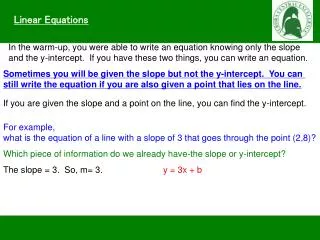
Displacement- Frame of Reference ∆x = f-i ∆x=f-i :-10-0 = -10 :10-0=0 f= -10 i=0
Variables for Linear Motion • d = displacement (∆x) • t = time of travel (∆t) • a = rate of constant acceleration • vi = initial velocity • vf = final velocity
Equation 1 • ā = ∆v / ∆t = (Vf-Vi)/(Tf-Ti); • a/1=(Vf-Vi)/t; • at=Vf-Vi; • atVvi=Vf; • Vf=Vi+at(equation # 1)
Equation 2 • v = ∆x/ ∆t; • ∆x=d, ∆t=t, V =1/2(vi+vf); • ½(Vi+Vf)=d/t; • t/2(Vi+Vf)=d or ½((Vi+Vf)t (equation # 2).
Equation 3 Vf=Vi+at #1 into ½((Vi+Vf)t d = ½(Vi + at + Vi)td = ½(2Vi + at)t d = (Vi + ½at)t (equation # 3)
Equation 4 • Vf= Vi +at; • Vf-Vi=at; • (Vf-Vi)/a=t. (i) • D=1/2(Vi+Vf)/[(Vf-Vi)/a]; • D=[(Vi+Vf)(Vf-Vi)]2a; • D=(VfVi+Vf^2-Vi^2VfVi)/2a • D=(Vf^2-Vi^2)/2a • 2ad=Vf^2-Vi^2 • Vf^2=2ad+Vi^2 (equation # 4).