Download
1 / 9
90 likes | 233 Vues
This text explores how societies govern themselves through formal sanctions, which are enforceable rules that may involve regulated combat, as seen in New Guinea. It outlines three primary methods for settling disputes: adjudication, where a third party makes a binding decision; negotiation, where parties reach an agreement independently or with assistance; and mediation, which involves an unbiased third party facilitating negotiation. Ethnographic examples, such as song duels among the Inuit and trial by ordeal in Togo, are discussed alongside contemporary issues like child soldiers in conflict zones.

E N D
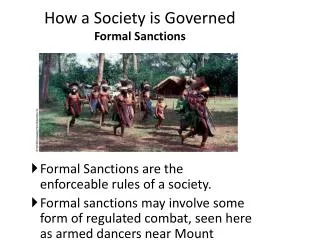
How a Society is Governed Formal Sanctions • Formal Sanctions are the enforceable rules of a society. • Formal sanctions may involve some form of regulated combat, seen here as armed dancers near Mount Hagen in New Guinea demand redress for murder.
Settling Disputes • A dispute may be settled in three ways: • Adjudication - An authorized third party issues a binding decision. • Ex: John took Mary’s laptop. Mary takes John and her case to Judge Judy. After both Mary and John present their sides of the story, Judge Judy awards the laptop back to Mary.
How a Society is Governed Lawan external control • Allocates authority to employ coercion to enforce sanctions. • Redefines social relations and aids its own efficient operation by ensuring it allows change.
Settling Disputes • A dispute may be settled in three ways: • Negotiation - the parties to the dispute reach an agreement with or without the help of a third party. • Ex: John took Mary’s laptop. Mary knows where John lives…Mary confronts John and after 20 minutes of conversation, convinces him to give her back the laptop.
Settling Disputes • A dispute may be settled in three ways: • Mediation – Settlement of a dispute through negotiation assisted by an unbiased third party. • Ex: John took Mary’s laptop. Mary and John both go to their school counselor to help them talk out who owns the laptop. With the advice of the counselor, both Mary and John agree that Mary is the rightful owner.
Settling Disputes Ethnographic Example Song Duels Having a song duel is the traditional approach to dispute resolution among the Inuit of northern Canada.
Settling Disputes Ethnographic Example Trial by Ordeal • Togo, West Africa • Trial to determine a yam thief
Warfare in Multinational States Example: Darfur (In the western part of both North and South Sudan)
Child Soldiers • Today, there are more than 250,000 child soldiers, many as young as 12 years old. Among them are these boys training to be guerrillas in Sahel, Eritrea. • Emmanual Jal (Former child soldier in Sudan): The “Lost Boys” More on the Civil War in Sudan that produced the new countries of North Sudan and South Sudan