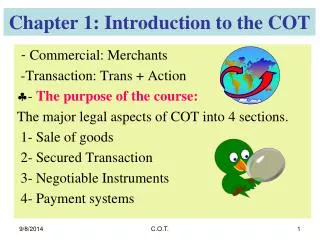
Chapter 1: Introduction to the COT
50 likes | 179 Vues
This chapter provides an overview of the legal principles governing the sale of goods within commercial transactions (COT). It explores the essential rules that facilitate and regulate the exchange of goods, ensuring a predictable, efficient, and fair marketplace while protecting consumers and discouraging anti-competitive practices. The chapter focuses on two primary sources of law: Decree #38, which governs sales and obligations in the applicable jurisdiction, and the United Nations Convention on Contracts for the International Sale of Goods (CISG), which applies to international sales agreements between signatory countries. ###


Chapter 1: Introduction to the COT
E N D
Presentation Transcript
Chapter 1: Introduction to the COT - Commercial: Merchants -Transaction: Trans + Action - The purpose of the course: The major legal aspects of COT into 4 sections. 1- Sale of goods 2- Secured Transaction 3- Negotiable Instruments 4- Payment systems C.O.T.
Chapter1:Introduction to sale of goods The exchange of goods is an essential part of every economy. Most countries have developed special rules governing. The special rules were developed with a common goal in mind: - To facilitate commercial activities - Predictable - Efficient - Fair - Protecting consumers - Discourage anti-competitive practices C.O.T.
LAW Sources of law governing the sale of goods • We will be relying on two laws: - The D#38 governing K and other obligation - Civil Code Rkmrdæb,evNI 2007 - The United nations convention for International sale of goods (CISG) 1-Decree#38 - Law governing, sale Ks (ch II section I, Art 34 – Art55) - Applies to all sales Ks, not just to Ks for sale of goods (real & personal property) C.O.T.
There some Arts are not consistent with free market principles. Such as: - Art12 Consideration from each party must be equal when there is different in consideration given, the party who receives less can rescind the K. (no profit) - Art 59 interest 5% per year 2- CISG: apply to - Only applies to sale of contract between different countries. - Only applies to countries that have signed the CISG C.O.T.
LAW • Basic Application of CISG A K B CISG Problem CISG A sues B Court looks at PIL (conflict of law) which country law will apply ? - If A country law CISG apply - If B country law CISG apply A K B no CISG Problem CISG A sues B, so the Court looks at PIL (conflict of law) which country law will apply ? - If A country law CISG not apply - If B country law CISG apply C.O.T.