Accessing resources
This initiative focuses on empowering organized women's groups in the quarrying sector through policy support and capacity-building programs. Despite facing social and political backlash from contractors and caste-based norms, women's groups are organized into federations and provided with literacy training. Key principles include understanding gender dynamics, acknowledging both productive and reproductive contributions, and recognizing institutional factors affecting sustainability. The program offers tailored courses in gender analysis, participatory research, and critical analysis to enhance agency and decision-making among women in the quarrying industry.

Accessing resources
E N D
Presentation Transcript
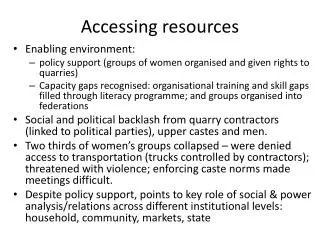
Accessing resources • Enabling environment: • policy support (groups of women organised and given rights to quarries) • Capacity gaps recognised: organisational training and skill gaps filled through literacy programme; and groups organised into federations • Social and political backlash from quarry contractors (linked to political parties), upper castes and men. • Two thirds of women’s groups collapsed – were denied access to transportation (trucks controlled by contractors); threatened with violence; enforcing caste norms made meetings difficult. • Despite policy support, points to key role of social & power analysis/relations across different institutional levels: household, community, markets, state
Key principles in gendering research • Disaggregation of data: Recognising the differences amongst women and men by age, stage in the life-cycle, class, ethnicity etc • Recognising the contribution of both productive and reproductive activities to household livelihoods (to avoid excessive time burdens) • Institutional analysis central to understanding sustainability, scalability and distributional effects: • Focus on decision-making and agency at different levels. • Not static, but change over time in response to both internal and external contextual shifts. • Interlinked, hence shift in one has implications for roles, status and identity across others.
Capacity-building • Short, tailor-made courses in: • Gender analysis and mainstreaming • Participatory action research • Research and critical analysis: • M. Res in Development Practice (through distance learning) • Research training through PhD programme – possibilities for joint supervision