Cultural and Scientific Advancements in Classical Greece: The Birth of Democracy
Explore the profound cultural and scientific achievements that defined Classical Greece during its golden age (477-431 BCE). This era saw the emergence of democracy, where citizens participated in governance, and significant contributions to art, architecture, literature, and philosophy flourished. Key figures such as Draco, Solon, and Cleisthenes laid the groundwork for democratic principles. Additionally, advancements in astronomy, mathematics, and philosophy by thinkers like Socrates and Aristotle shaped Western thought. The legacy of Greek democracy strongly influenced modern governance, including the United States.

Cultural and Scientific Advancements in Classical Greece: The Birth of Democracy
E N D
Presentation Transcript
Cultural and Scientific Advancements CLASSICAL GREECE
Scientific and Cultural Advancements DEMOCRACY • DEMOCRACY • DEMOCRACY • DEMOCR CULTURAL AC CULTURAL SCIENTIFIC
Cultural Contributions • Democratic principles and classical culture flourished during Greece’s golden age (477-431 BCE) – a its height, Greece set lasting standards in politics, art, architecture, literature, and philosophy that are still influential today. • Hellenistic Culture – refers to the blending of Greek culture as well as Egyptian, Persian, and Indian cultures
Government – The First Democracy • Origins of Democracy in Greece were to eliminate the power struggles between the rich and poor – allow all citizens to participate in government
The First Democracy Continued • Draco took power in 621 BCE • Created a legal code that punished the rich and poor equally (first steps towards democracy)
The First Democracy Continued • Solon took power in 594 BCE • Outlawed debt slavery (no citizen should “own” another) • Divided Athens into four social classes (top three could hold office, all others could participate in assembly) • Citizens were permitted to bring charges of wrongdoing against another
The First Democracy Continued • Cleisthenes took power in 500 BCE • Broke up nobility, instead, he divided people into ten classes based on region, not wealth • All citizens could submit ideas for laws
The First Democracy Continued • Eventually, Greek Democracy looked like this: • Direct democracy • Citizens: male; 18 years old; born of citizen parents • Laws voted on and proposed directly by assembly of all citizens • Executive Branch composed of a council of 500 men • Juries varied in size • No attorneys; no appeals, one-day trials
The First Democracy Continued • How Greece’s Democracy influenced the US • Political power exercised by the citizens • Three branches of government • Legislative Branch makes the laws • Executive Branch carries out the laws • Judicial Branch conducts trials with paid jurors
NOTES - Democracy • Created to appease ALL people • First Democracy • Direct Democracy • Influenced US Government
The Arts • Sculpture – portrayed ideal beauty, then realism • Pottery • Greek Drama • History – written history as well as oral traditions • Homer – Iliad and Odyssey
Greek Drama • Leadership • Duties to the Gods • War • Humor • Justice • Love and Hate • Betrayal • Self-Criticism With one other student, discuss modern television shows or movies that have similar subject matter/themes.
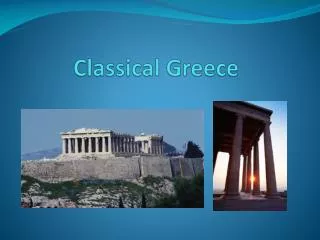
Architecture • Parthenon • Columns
Literature and Philosophy • Philosophers are “great thinkers” who are seeking the “truth” • Socrates • Plato • Aristotle • Stoicism • Epicureanism
Socrates Wanted people to think about their values and actions.
Plato Wrote about a perfectly governed society – The Republic.
Aristotle Developed rules of logic – basis of the Scientific Method.
Notes – Cultural Contributions • Sculpture, Pottery • Drama, History, epic poems (Homer) • Philosophers (Socrates, Aristotle, Plato)
Scientific Contributions • Astronomy • Aristarchus estimated that the sun was 300 times the size of the Earth (underestimate) and that the Earth and other planets revolved around the sun – took awhile to catch on • Eratosthenes attempted to calculate the Earth’s size
Scientific Contributions Continued • Mathematics and Physics • Euclid wrote Elements which contained the basis for Geometry • Archimedes estimated Pi – his ideas eventually enabled Hellenistic scientists to build a force pump and a stream engine • Pythagoras – he had a theorem
Notes – Scientific Contributions • Astronomy – Earth revolves around sun • Geometry – Pi and Pythagorean Theorem