Download
1 / 2
20 likes | 141 Vues
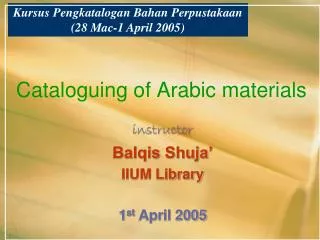
Join us for a one-day intensive course on cataloguing Arabic materials presented by instructor Balqis Shuja at IIUM Library. This course (April 1, 2005) will provide essential skills in Arabic cataloguing, emphasizing transliteration, Arabic name authority, technical reading, online catalogue searching, bibliographic relationships, subject analysis, and creating effective catalogue records. Course materials are in English, and sessions will be conducted in Malay. Equip yourself with vital bibliographic tools and enhance your cataloguing expertise!

E N D
KursusPengkataloganBahanPerpustakaan(28 Mac-1 April 2005) Cataloguing of Arabic materials instructor Balqis Shuja’ IIUM Library 1st April 2005
Cataloguing of Arabic materials ۞A one-day course to provide what Arabic cataloguing entails ۞ Course materials are in English but session will be conducted in Malay. ۞ Course outline: 1) Transliteration; 2) Arabic name authority; 3) Technical reading; 4) Searching the online catalogue; 5) Bibliographic relationships; 6) Subject analysis; 7) Creating the catalogue record; 8) Shelflisting ۞ Bibliographic and cataloguing tools: 1) AACR2R and its associate references; 2) ALA-LC Romanization tables; 3) LCSH and its associate texts; 4) LCC scheme; 5) Zirikli’s al-A’lam; 6) Brockelmann; 7) Mu’jam al-mu’allifin Overview and introduction