Download
1 / 10
100 likes | 219 Vues
This text explores the fundamental concepts of work, force, and motion in relation to machines. It defines work and discusses the units used to measure it, clarifying common misconceptions about work and motion. The role of machines in making work easier is examined, focusing on how they alter force, distance, and direction. Key concepts include input and output forces, work calculations, mechanical advantage, and efficiency. Factors like friction are also considered as they affect the performance of machines, providing a comprehensive overview of how machines facilitate tasks in our lives.

E N D
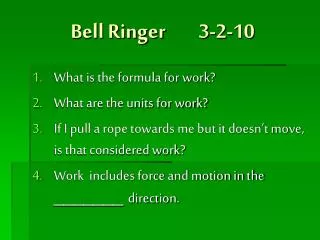
Bell Ringer 3-2-10 • What is the formula for work? • What are the units for work? • If I pull a rope towards me but it doesn’t move, is that considered work? • Work includes force and motion in the _______ direction.
Machines are devices that make it easier to do work. • Machines change the way a person does work, not the amount of work that needs to be done.
How do Machines make work Easier? • By changing the amount of force you exert • By changing the distance over which you exert the force • By changing the direction in which you exert the force.
Input force is the force you exert on a machine. • The input force moves the machine a certain distance, called the input distance. • Input Force x Input Distance = Input Work
Output force is the force a machine puts on an object. • The output distance is the distance over which the machine exerts the force. • Output force x Output Distance = Output Work
Mechanical advantage is the number of times a machine increases a force exerted on it. • Mechanical advantage = Output force Input force
Some machines make work easier by allowing you to exert a smaller force over a longer distance. • Other machines allow you to exert your force over a shorter distance. • Other machines allow you to change the direction of input force
Efficiency is the ability to convert input work to output work, calculated as: • Efficiency = output work x 100% input work . • Oil, or another lubricant, can increase efficiency.
Friction reduces efficiency by converting some work into heat. • The efficiency of a real machine is always less than 100 percent because of friction.