Download
1 / 24
240 likes | 367 Vues
This detailed overview of copper extraction outlines the five key stages: Open Pit Mining, Pit Crushing, Froth Flotation, Smelting, and Electrolytic Refining. Open pit mining, exemplified by the Bingham Canyon mine, employs explosives to access low-grade copper ore. The process continues with crushing and then froth flotation to concentrate the copper from the ore. Further refinement involves smelting to produce molten copper, which is then purified through electrolytic refining, resulting in copper of 99.98% purity. Each stage plays an essential role in copper production.

E N D
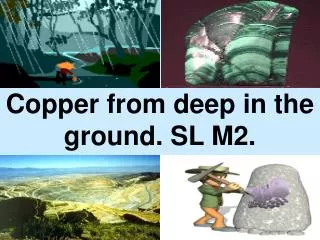
Five stages: • Open Pit mining • Pit crusher 0.6% Cu • Froth floatation 30% Cu • Smelting 90.4% Cu • Electrolytic refining 99.98% Cu
chalcopyrite malachite azurite
CuFeS2 = chalcopyrite. % Cu in pure chalcopyrite?
% by mass = mass of element in 1 mole of compound x 100 Mr of compound % by mass = 64 x 100 = 35% 184 CuFeS2 Mr = 64+56+32+32 = 184
Open Pit mining. Bingham Canyon Low grade copper Quantities huge Dynamite used Shavings tested Waste to tips
Open Pit mining. • Noisy • Dusty • Leaves Open Pits • Waste tips.
Pit crusher 0.6% Cu 2.5cm pieces
Froth Floatation • Tailings 0.6% Collector (oil) molecules attach themselves to the chalcopyrite grains. The grains are now water-repellent. Air bubbles attract the grains. Froth produced and is pumped away to smelter. • Detergent • Oil • Water 30% concentrating
Smelting • First stage involves • Silica • Oxygen • Concentrate • Cu2S made • Most important stage involves Cu2S / air / furnace • Cu2S(l) + O2(g) 2Cu(l) + SO2(g)
Oxidised or reduced? Cu2S + O2 2Cu + SO2 reduced Cu +1 0 oxidised S -2 +4 O reduced 0 -2 What mass of copper could be obtained by reducing 1kg of copper (I) sulphide?
What mass of copper could be obtained by reducing 1kg of copper (I) sulphide? Cu2S + O2 2Cu + SO2 Underline 1 mol 2 mol Moles in Mass in 160 128 Mass in question 1kg 0.800kg
Smelting Acid rain Trees Sulphur dioxide made. Lakes H2SO4 30% 99.4%
99.4% 99.98% Electrolytic Refining The copper anodes are already 99.4% copper! The copper cathodes will be 99.98% copper!
- Cathode Anode + Cu Cu2+ Cu2+ e- e- Cu Cu Cu2+ Cu e- e- Cu2+
Describe what is happening at the anode. • Write an equation. • Is this oxidation or reduction? - Cathode Anode + Cu Cu2+ Cu2+ e- e- Cu Cu Cu2+ Cu e- e-
Describe what is happening at the cathode. • Write an equation. • Is this oxidation or reduction? - Cathode Anode + Cu Cu2+ Cu2+ e- e- Cu Cu Cu2+ Cu e- e- Cu2+
Write an equation. • Cu(s) Cu2+(aq) + 2e- • Is this oxidation or reduction? • Oxidation - Cathode Anode + Cu Cu2+ Cu2+ e- e- Cu Cu Cu2+ Cu e- e-
Write an equation. • Cu2+(aq) + 2e- Cu(s) • Is this oxidation or reduction? • Reduction - Cathode Anode + Cu Cu2+ Cu2+ e- e- Cu Cu Cu2+ Cu e- e- Cu2+
Five stages: • Open Pit mining • Pit crusher • Froth floatation • Smelting • Electrolytic refining