Understanding Enzyme Kinetics: The Role of Catalysts in Reactions
This guide dives into the fundamentals of enzyme kinetics, exploring the concept of kinetics, represented by activation energy (Ea). It outlines the factors affecting collision rates among reactants, the impact of catalysts, and why enzymes are specific types of proteins that facilitate reactions. Learn about the lock-and-key and induced fit models, along with the methodology for studying enzyme reactions. An experiment involving the comparison of absorbance rates is outlined, including negative control procedures with catechol and water, aimed at enhancing understanding of enzyme activity.

Understanding Enzyme Kinetics: The Role of Catalysts in Reactions
E N D
Presentation Transcript
What is “Kinetics”? • Determined by: • Represented by
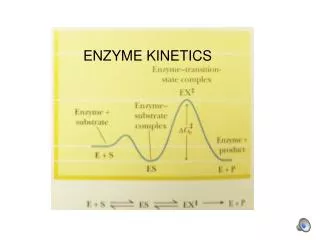
Activation Energy, Ea • What can effect Eact1 Eact-1
Collisions • Reactants must __________________________ for a reaction to occur • What can affect the rate of collisions?
What is a Catalyst? • a substance that • The rate is usually increased • This is accomplished by • Cannot make a reaction occur that • Only changes how a reaction can occur
Examples of Catalysts • Acids • Bases • Metals • Enzymes
What are Enzymes? • Enzymes are a specific type of • Proteins are • Proteins are what your provides the codes to make • catalysts • Enzymes are that reactions in systems
Lock and Key Model Induced Fit Model How Do Enzymes Work? Enzyme Substrate Product
What Reaction Will We Be Studying? • This reaction occurs • The natural reaction rate is so • RUN A NEGATIVE CONTROL WITH JUST CATECHOL AND WATER • MEASURE THE ABSORBANCE AND RECORD THE TIME • MEASURE THE ABSORBANCE AND TIME AFTER ALL OF THE OTHER EXPERIMENTS • CALCULATE (ABS2-ABS1)/(TIME2-TIME1) = RATE + ½ O2 + H2O
Your Goals • You need to indicate • You accomplish this by plotting and • We will collect class data BEFORE YOU LEAVE THE LAB
Broccoli Experiment Starts Today • Begin to do this BEFORE the apple experiment • We just need to dry the broccoli today • Clean a crucible • Weigh broccoli (15g) in crucible • Heat on a hot plate to dehydrate • May have to mix occasionally • Store in personal drawer until next lab • HAVE A GREAT VACATION!!!