Download
1 / 7
80 likes | 218 Vues
This workshop session focuses on the critical components of NIH grant writing, particularly biosketches and letters of cooperation. It emphasizes the importance of effectively marketing yourself and your team through your biosketch, which should highlight your qualifications, contributions to science, and relevant experiences. Additionally, the session outlines the necessity of including letters of cooperation to validate your partnerships and support. You'll gain practical advice on presenting your team, documenting work sites, and ensuring all necessary letters are included in your grant application.

E N D
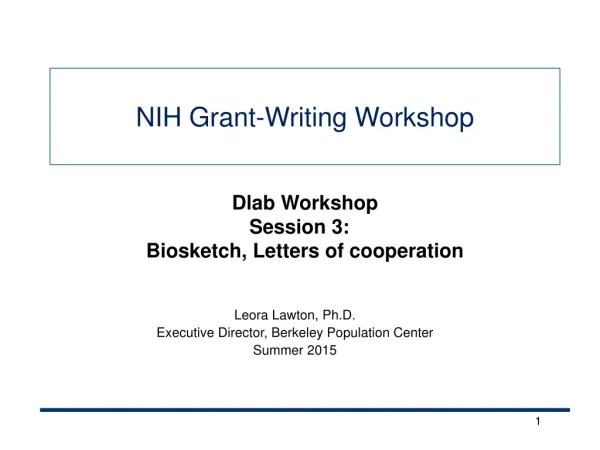
NIH Grant-Writing Workshop DlabWorkshop Session 3: Biosketch, Letters of cooperation Leora Lawton, Ph.D. Executive Director, Berkeley Population Center Summer 2015
Presenting the Team • Part of your story is selling yourself and your team members, that is, are you (and your team members) capable of doing the work, will you have time and commitment, and do you have all the required expertise to pull it off successfully? • There is the PI, and may be co-investigators and other key personnel, postdocs, graduate students, data analysts, and other subject matter and technical experts.
Biosketches • Biosketches are not a reformatting of your CV. Rather, it’s a marketing piece about you as a researcher. It contains: • Personal statement – why your career past and future trajectory make you qualified. You might include a relevant citation here. • CV components – documentation of your work experience and accomplishments for being matched to what you propose to do. • You want to present almost any kind of role, honor and award • “Contributions to Science” – this is a new feature that summarizes your areas of research, and includes relevant, primary citations. • Publications –Personally, I think it would help, in a dissertation award only, to show recent presentations at major meetings. • Grants – do you have a track record of bringing in work. (obviously not as relevant for dissertation grants). • (Look at biosketch examples).
Presenting the Team • Each site where work will take place must be listed in the application document • Duns Number, address, congressional district, contact, etc. • There are partners (need letters), vendors (need letters, scope, budget and other documents), and subawards (need letters, scope, other documents, budget). • A subaward is when an investigator at another institution wants to be paid for more than travel, etc., but with, say, a summer month. Subawards are a bit more complex. These should be handled largely by a grant analyst but they need to know early that there will be a subaward because they can be time-consuming to get.
Letters of Cooperation • Letters back up your statements that people will work with you the way you are saying they will. • Every person and organization outside of Cal mentioned absolutely must have a letter attached. • At your own institution, many advise including letters for key personnel when: • You are enlisting support of institutional resources that don’t have to support your program or department. • You claimed something that Deans or other administrators can back up, e.g., regarding course buy-outs, recruits. • You have Sponsors/mentors
Letters of Support • The letters offer proof others are on board and know what they are being asked to do. It should mirror what you said elsewhere. • It should be on letterhead, signed. • Dear PI:I am pleased to support your NIH XX grant application titled “TITLE”. I will be providing analysis of the data using specific algorithms, conducting literature reviews, providing expertise in certain subject matters, supervising staff, cleaning data, writing articles….I will make these contributions during the following time period of the project (e.g., years 2 and 3 of 5).SignedxxxChris Colleague
Homework • Revise your Specific Aims • Try writing a Personal Statement for your project. • Biosketch example and instructions: http://grants.nih.gov/grants/funding/424/index.htm#biosketch • Optional: identify possible grant vehicles (e.g., R03), ICs (e.g. NIA), research program (e.g., behavioral and social research), and program official (e.g., GeorgeannePatmios).