Leveraging Social Media for Urban Dynamics: An Agent-Based Model Approach
250 likes | 394 Vues
This research aims to develop an urban dynamics model using crowd-sourced data from Twitter in Leeds. The focus is on estimating individual behaviors and social patterns through spatial and text mining of tweets, analyzing actions such as commuting and socializing. By integrating this data with agent-based modeling, the goal is to create a nuanced understanding of urban dynamics and improve model calibration and validation. The study seeks to overcome challenges in data quality and resolution, contributing to the evolving landscape of social simulation and urban studies.


Leveraging Social Media for Urban Dynamics: An Agent-Based Model Approach
E N D
Presentation Transcript
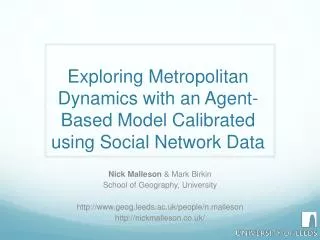
Estimating Individual Behaviour from Massive Social Data for AnUrban Agent-Based Model Nick Malleson & Mark Birkin School of Geography, University ESSA 2012
Outline • Research aim: develop a model of urban-dynamics, calibrated using novel crowd-sourced data. • Background: • Data for evaluating agent-based models • Crowd-sourced data • Data and study area: Twitter in Leeds • Establishing behaviour from tweets • Integrating with a model of urban dynamics
Agent-Based Modelling • Autonomous, interacting agents • Represent individuals or groups • Usually spatial • Model social phenomena from the ground-up • A natural way to describe systems • Ideal for social systems
Data in Agent-Based Models • Data required at every stage: • Understanding the system • Calibrating the model • Validating the model • But high-quality data are hard to come by • Many sources are too sparse, low spatial/temporal resolution • Censuses focus on attributes rather than behaviour and occur infrequently • Understanding social behaviour • How to estimate leisure times / locations? • Where to socialise?
Crowd-Sourced Data for Social Simulation • Movement towards use of massive data sets • Fourth paradigm data intensive research (Bell et al., 2009) in the physical sciences • “Crisis” in “empirical sociology” (Savage and Burrows, 2007) • New sources • Social media • Facebook, Twitter, Flikr, FourSquare, etc. • Volunteered geographical information (VGI: Goodchild, 2007) • OpenStreetMap • Commercial • Loyalty cards, Amazon customer database, Axciom • Potentially very useful for agent-based models • Calibration / validation • Evaluating models in situ (c.f. meteorology models)
New Paradigms for Data Collection • (Successful) mobile apps to collect data • Offer something to users • New methodology for survey design (?) • E.g. mappiness • Ask people about happiness • Relate to environment, time, weather, etc.
Data and Study Area • Data from Twitter • Restricted to those with GPS coordinates near Leeds • ‘Streaming API’ provides real-time access to tweets • Filtered non-people and those with < 50 tweets • Before Filtering • 2.4M+ geo-located tweets (June 2011 – Sept 2012). • 60,000+ individual users • Highly skewed: 10% from 32 most prolific users • After Filtering • 2.1M+ tweets • 7,500 individual users • Similar skew (10% from 28 users)
Temporal Trends • Hourly peak in activity at 10pm • Daily peak on Tuesday - Thursday • General increase in activity over time • Old data…
Identifying actions • Need to estimate what people are doing when they tweet (the ‘key’ behaviours) • Analyse tweet text • Automatic routine • Keyword search for: ‘home’, ‘shop’, ‘work’ • ‘Home’ appears to be the area with the highest tweet density • Unfortunately even tweets that match key words are most dense around the home
Spatio-temporal text mining • Individual tweets show why keyword search fails: • Work: “Does anyone fancy going to work for me? Don’t want to get up” • Home: “Pizza ordered ready for ones arrival home” • Shop: “Ah the good old sight of The White Rose shopping centre. Means I’m nearly home” • But still potential to estimate activity. • E.g. “I’m nearly home” • Combination of spatial and textual analysis is required • Parallels in text mining (e.g. NaCTeM) and other fields (e.g. crime modus operandi or The Guardian analysis of recent British riots) • New research direction: “Spatial text mining” ?
Analysis of Individual Behaviour – Anchor Points • Spatial analysis to identify the home locations of individual users • Some clear spatio-temporal behaviour (e.g. communting, socialising etc.). • Estimate ‘home’ and then calculate distance from home at different times • Journey to work?
Spatio-Temporal Behaviour • More important than aggregate patterns, we can identify the behaviour of individual users • Estimate ‘home’ and then calculate distance at different times • Could estimate journey times, means of travel etc. • Very useful for calibration of an ABM
Activity Matrices (I) ‘Raw’ behavioural profiles Interpolating to remove no-data Once the ‘home’ location has been estimated, it is possible to build a profile of each user’s average daily activity The most common behaviour at a given time period takes precedence
Activity Matrices (II) • Overall, activity matrices appear reasonably realistic • Peak in away from home at ~2pm • Peak in at home activity at ~10pm. • Next stages: • Develop a more intelligent interpolation algorithm (borrow from GIS?) • Spatio-temporal text mining routines to use textual content to improve behaviour classification
Towards A Model of Urban Dynamics (I)Microsimulation • Simulation are: Leeds and a buffer zone • Microsimulation to synthesise individual-level population • ~80M people in Leeds • 2.08M in simulation area • Iterative Reweighting • Useful attributes (employment, age, etc.) • Data: UK Census • Small Area Statistics • Sample of Anonymised Records
Towards A Model of Urban Dynamics (II) Commuting • Estimate where people go to work from the census • Model parameters determine when people go to work and for how long. • Sample from a normal distribution • Parameters can vary across region
Towards A Model of Urban Dynamics (II) Calibration • Calibrate these parameters to data from Twitter (e.g. ‘activity matrices’) • Large parameter space • 4 * NumRegions • Use (e.g.) a genetic algorithm
Videos.. A video of the prototype model running is available online: http://youtu.be/wTw_Sv6aaz0
Computational Challenges • Handling millions of agents… • Memory • Runtime • Especially in a GA! • History of actions • Managing data • Spatial analysis • GIS don’t like millions of records • E.g. hours to do a simple data calculation • Storage (2Gb+ database of tweets) • Simple analysis become difficult • Too much data for Excel
Data and Ethical Challenges • Data bias: • Sampling • 1% sample (from twitter) • <10% sample (from GPS) • Who’s missing? • Enormous skew • Large quantity generated by small proportion of users • Similar problems with other data (e.g. rail travel smart cards, Oyster) • Some solutions? • Geodemographics • Linking to other individual-level data sets? • Ethics
Conclusions • Aim: develop a model of urban-dynamics, calibrated using novel crowd-sourced data. • New “crowd-sourced” data can help to improve social models (?) • Possibly insurmountable problems with bias, but methods potentially useful in the future • Particularly in terms of how to manage the data/computations • Improved identification of behaviour • New ways to handle computational complexity • In situ model calibration
Thank you Nick Malleson & Mark Birkin, School of Geography, University of Leeds http://www.geog.leeds.ac.uk/people/n.malleson http://nickmalleson.co.uk/