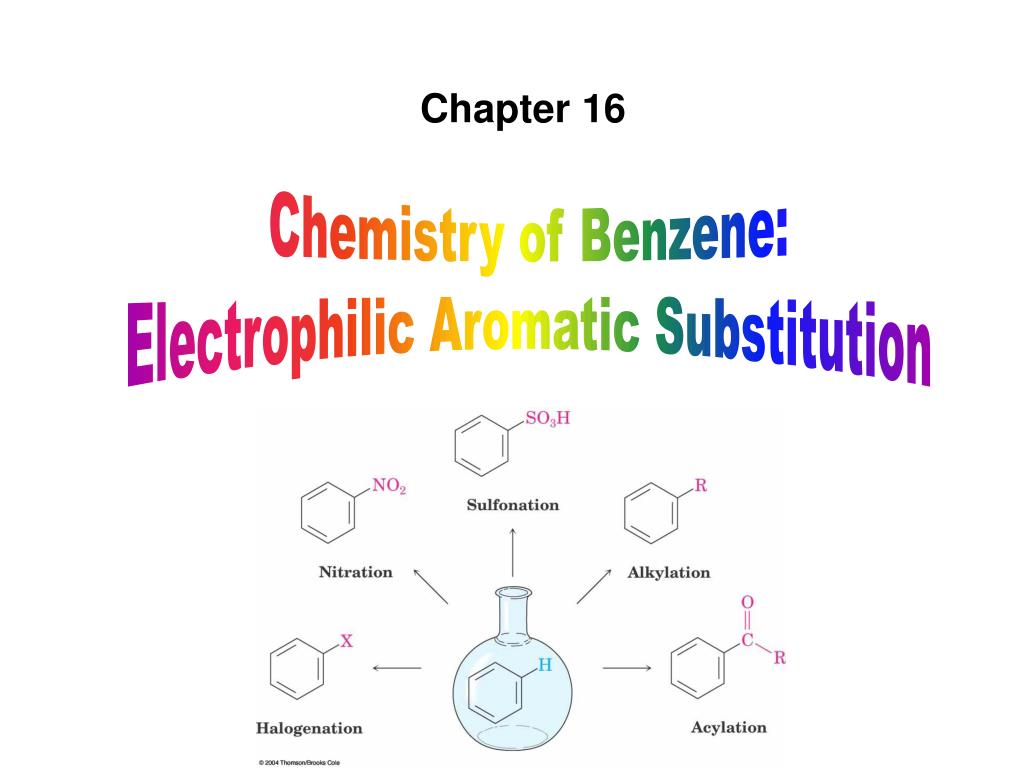
Chapter 16. Chemistry of Benzene: Electrophilic Aromatic Substitution. Introduction. Electrophilic aromatic substitution is the most common reaction of aromatic compounds It replaces a proton ( H + ) on an aromatic ring with another electrophile ( E + )
01 / 134Chemistry of Benzene: Electrophilic Aromatic Substitution
1 / 17
Télécharger la présentation
Chemistry of Benzene: Electrophilic Aromatic Substitution
Une image / un lien ci-dessous est fourni (tel quel) pour télécharger la présentation
Politique de téléchargement : le contenu du site vous est fourni TEL QUEL pour votre information et votre usage personnel ; il ne peut être vendu, concédé sous licence ni partagé sur d’autres sites sans l’accord de son auteur.Le contenu vous est fourni TEL QUEL, pour votre information et votre usage personnel uniquement.Téléchargez la présentation en cliquant sur ce lien.Lors du téléchargement, si vous ne parvenez pas à télécharger une présentation, l’éditeur a peut-être supprimé le fichier de son serveur.Pendant le téléchargement, si vous ne parvenez pas à obtenir une présentation, le fichier a peut-être été supprimé par l’éditeur.
F I N
Plus de contenu associé
Transcription de la présentation
Chapter 16 Chemistry of Benzene: Electrophilic Aromatic Substitution
Introduction • Electrophilic aromatic substitution is the most common reaction of aromatic compounds • It replaces a proton (H+) on an aromatic ring with another electrophile (E+) • It leads to the retention of the aromatic core
1.Bromination of Aromatic Rings • Benzene is a site of electron density • Its 6 electrons are in a cyclic conjugated system • Its 6 electrons are sterically accessible to other reactants because they are located above or below the plane
Benzene acts as an electron donor (a Lewis base or nucleophile) • It reacts with electron acceptors (Lewis acids or electrophiles) • Benzene’s electrons participate as a Lewis base in reactions with Lewis acids
Bromination of benzene occurs in two steps: • Step 1: The electrons act as a nucleophile toward Br2 (in a complex with FeBr3) to form a nonaromatic carbocation intermediate • Step 2: The resonance-stabilized carbocation intermediate loses H+ to regenerate the aromatic ring
Electrophilic Aromatic Bromination • Aromatic rings are less reactive toward electrophiles than alkenes • Unlike alkenes, benzene does not react rapidly with Br2 in CH2Cl2 • For bromination, benzene requires FeBr3 as a catalyst to polarize the bromine reagent and make it more electrophilic
Step 1: The electrons act as a nucleophile and attack the polarized Br2 (in a complex with FeBr3) to form a nonaromatic carbocation intermediate • It is a slow, rate-limiting step (high DG‡) • The carbocation is doubly allylic (nonaromatic) and has three resonance forms
Step 2: The resonance-stabilized carbocation intermediate loses H+ to regenerate the aromatic ring and yield a substitution product in which H+ is replaced by Br+ • It is similar to the 2nd step of an E1 reaction • The carbocation intermediate transfers a H+ to FeBr4- (from Br- and FeBr3) • This restores aromaticity (in contrast with addition in alkenes)
Why is there electrophilic aromatic substitution rather than addition? • Substitution reaction retains the stability of the aromatic ring and is exergonic Addition Loss of aromaticity Endergonic Substitution Retention of aromaticity Exergonic
2.Other Aromatic Substitutions • The reaction with bromine involves a mechanism that is similar to many other reactions of benzene with electrophiles • The cationic intermediate was first proposed by G. W. Wheland and is often called the Wheland intermediate
Electrophilic Aromatic Substitution • An electrophilic aromatic substitution reaction involves two steps: • reaction of an electrophile E+ with an aromatic ring • loss of H+ from the resonance-stabilized carbocation intermediate to regenerate the aromatic ring
Aromatic Chlorination • Benzene ring reacts with Cl2 in the presence of FeCl3catalyst to yield chlorobenzene • It requires FeCl3 to polarize Cl2 (make it more electrophilic)
Aromatic Iodination • Benzene ring reacts with I2 in the presence of anoxidizing agent (H2O2or CuCl2) to yield iodobenzene • Iodine must be oxidized to form a more powerful electrophilic I+ species (with Cu2+ or peroxide)
Aromatic Nitration • Benzene ring reacts with a mixture of concentrated nitric and sulfuric acids (HNO3 and H2SO4) to yield nitrobenzene • The combination of nitric acid and sulfuric acid produces NO2+ (nitronium ion), an electrophile
Aromatic Sulfonation • Benzene ring reacts with fuming sulfuric acid (a mixture of H2SO4and SO3) to yield benzenesulfonic acid • The reactive electrophile is either HSO3+ or neutral SO3depending on reaction conditions
Friedel-Crafts alkylation – is an electrophilic aromatic substitution in which the electrophile is a carbocation, R+. • AlCl3catalyst promotes the formation of the alkyl carbocation, R+, from the alkyl halide, RX • The Wheland (carbocation) intermediate forms • Alkylation is the attachment of an alkyl group to benzene; R+ substitutes for H+
Limitations of the Friedel-Crafts Alkylation • Only alkyl halides can be used (F, Cl, Br, I) • Aryl halides and vinylic halides do not react (their carbocations are too high in energy to form)
Limitations of the Friedel-Crafts Alkylation • Only alkyl halides can be used (F, Cl, Br, I) • No reaction occurs if the aromatic ring has an amino group or a strongly electron-withdrawing group substituent • It is difficult to control the reaction. Multiple alkylations can occur because the first alkylation is activating • Carbocation rearrangements occur during alkylation, particularly when a 1o alkyl halide is used
4.Acylation of Aromatic Rings: The Friedel-Crafts Reaction • Benzene ring reacts with a carboxylic acid chloride, RCOCl, in the presence of AlCl3 catalyst to yield an acylbenzene • Acylation is the attachment of an acyl group,-COR, to benzene; RCO+ substitutes for H+
Friedel-Crafts acylation – is an electrophilic aromatic substitution in which the reactive electrophile is a resonance-stabilized acyl cation, RCO+. • AlCl3catalyst promotes the formation of the acyl cation, RCO+, from the acyl chloride, RCOCl • The acyl cation, RCO+, does not rearrange; it is resonance-stabilized • The Wheland (carbocation) intermediate forms
In Friedel-Crafts acylation, there is no carbocation rearrangement nor multiple substitution • No carbocation rearrangement: The acyl cation, RCO+, does not rearrange because it is resonance-stabilized by interaction of the vacant orbital on C with lone pair of electrons on O • No multiple substitution: Acylated benzene is less reactive than nonacylated benzene
Connexion au compte
Connectez-vous pour publier votre contenu sur SlideServe.