Lightning feedbacks on climate
This analysis explores the intricate relationship between lightning and climate dynamics, focusing on how lightning produces nitrogen oxides (NOx) through channel heating and the dissociation of N2 and O2. NOx is a significant ozone producer in the free troposphere, where ozone serves as a potent greenhouse gas. With a variable lifetime and dependence on latitude, we examine how increasing flash frequency correlates with global warming and its effects on climate feedback mechanisms. The potential impact of intensified tropical lightning on global circulations is also considered.

Lightning feedbacks on climate
E N D
Presentation Transcript
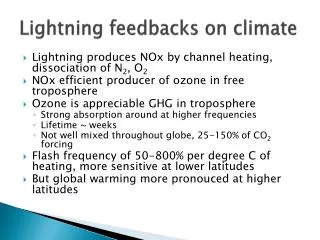
Lightning feedbacks on climate • Lightning produces NOx by channel heating, dissociation of N2, O2 • NOx efficient producer of ozone in free troposphere • Ozone is appreciable GHG in troposphere • Strong absorption around at higher frequencies • Lifetime ~ weeks • Not well mixed throughout globe, 25-150% of CO2 forcing • Flash frequency of 50-800% per degree C of heating, more sensitive at lower latitudes • But global warming more pronouced at higher latitudes
Increased pollution and thunderstorms will also increase Nox mass transport to free troposphere • However, water vapor is a sink of upper tropospheric ozone in presence of sunlight • Studies have suggested possible lightning ozone climate feedback • IF LIGHTNING IS PREFERENTAILLY INCREASED IN THE TROPICS, WHAT EFFECT COULD THAT HAVE ON GLOBAL CIRCULATIONS?