the consequences of WW2
200 likes | 421 Vues
the consequences of WW2. Human cost. 40 millions dead in Europe Two-third were civilians One-fifith of Poland’s population died 20 million people displaced. Economic cost. WW1 fighting took place mostly on the Western Front while during WW2 entire Europe was involved.


the consequences of WW2
E N D
Presentation Transcript
Human cost • 40 millions dead in Europe • Two-third were civilians • One-fifith of Poland’s population died • 20 million people displaced
Economic cost • WW1 fighting took place mostly on the Western Front while during WW2 entire Europe was involved. • Aerial bombing destroyed many cities • Transport and communication disrupted • Industry destroyed • Farmland ruined • Food production fell to half • 150 million people dependent on relief food distribution • Britain was bankrupted • Soviet economy badly effected-25 millions homeless
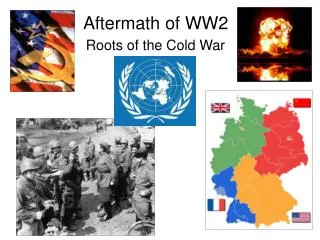
Political consequences • Poland saw its border shifted westwards- lost 179,000 sq.km in the east and gained 104,000 sq.km from German territories • Yalta Conference- decided Poland’s boundaries • Germany to be dicided into four zones • Poland, Hungary, Bulgaria and Czechoslovakia one party regime under Stalin’s control.
Effects of war on international relations • Change in the balance of power. • USSR and USA emerged as super powers
Reasonsmilitary • USA had acquired the largest air force in the world, 12 million men in the armed forces, more naval vessels and the atomic bomb • USSR had acquired the largest land army in the world to defeat Germany • France and Britain’s inability to defeat Germany placed them second in rank • USSR lacked strong military neighbours thus making it a regional power
Reasonseconomic • USA’s economy was strengthened by the war. It was able to out-produce all the other powers • USA was committed to more ‘open’ trade. • Small Eastern European countries needed support of a stronger neighbour which was provided by USSR
Impact of the superpowers • The map of europe after 1945 was determined by the growing conflict between USSR and USA with a clear dicvide between Eastern and Western Europe • USA- end of isolationism, beginning of a dominant role in world affairs • Cold War
Eastern Europe • 1944-48 Stalin established control over Hungary, Czechoslovakia, East Germany, romania and Poland which involved • i. establishment of one-party rule • ii. Nationalization of private enterprise • Iii. Five- Year Plans- encouraged collective farming • Each satellite state had to produce what USSR needed- eg Poland produced coal
The economic and political system was backed by: • Social and ideological controls eg. Cominform, secret police • Censorship of all media • Suppression of religious freedom • Military presence of soviet troops • Political purges
Western Europe • Followed democracy • Commitment by USA- the Truman Doctrine, Marshall Aid • Establishment of NATO
Impact on asia • China lost 12 million people • Japan lost 2 million people
Japan • Eliminated as amajor power • Occupied by the Americans under General Douglas macArthur • Japan was made a democracy • Military and secret police forces were dissolved • The emperor remained to maintain political stability
The treaty of san francisco • Signed in 1951- japan to • 1. renounce all claims to Taiwan, Sakhalin and the Kuriles • 2. hand over the Pacific Island of Micronesia to UN • 3. hand over the Ryuku and Bonin Islands to USA • 4. accepted the judgements of the international military Tribunal for the Far East • 4. Guidelines for reparation and compensation to prisoners of war, renounced future military aggression, nullified prior treaties
A separate Treaty between Japan and USA- • USA promised to defend Japan until it could look after its own defense which meant that it had military bases in Japan
china • Fighting continued between the nationalist forces of Jiang jieshi and the communist forces of Mao Zedong • Conflict led to the victory of Mao in 1949 and the establishment of a communist China
Decolonisation: the decline of european influence in asia • Weakness of Britain and France found it increasingly difficult to hold on to their empires in Asia and Africa • Nationalist Movements grew • USA and the UN condemned imperialism • Indonesia got independence from Dutch, Vietnam from the French, India, Burma and Ceylon from the british • USA and USSR sought to increase their sphere of influence in this area- Cold War
Other effects • War Tribunals established • The united nations • The Arms Race
Assignment • What was the impact of World War II on the following: • The popularity and spread of communism? • The defeated powers- Germany and Japan? • What was the impact of WWI and WWII on the roles and status of women?