Probing Stellar Evolution: Insights from the Harvard-Smithsonian Center for Astrophysics
280 likes | 388 Vues
This research explores the complex evolution of stellar systems, detailing the life cycle of stars from their birth to their ultimate demise. It emphasizes the fundamental parameters influencing stellar life, such as mass and fuel type (hydrogen, helium, carbon), and the consequent evolutionary stages including white dwarfs, neutron stars, and black holes. Utilizing photometry and CMDs (Color-Magnitude Diagrams), the study investigates star formation histories, while introducing innovative methods to analyze uncertainties in isochrones and detection probabilities. Case studies, like the Small Magellanic Cloud (SMC), provide practical insights into observed star formation dynamics.


Probing Stellar Evolution: Insights from the Harvard-Smithsonian Center for Astrophysics
E N D
Presentation Transcript
Probing the evolution of stellar systems Andreas Zezas Harvard-Smithsonian Center for Astrophysics
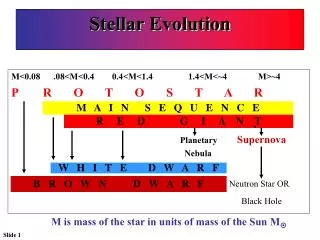
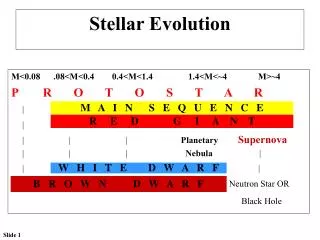
The lives of stars : fighting against gravity • Defining parameter : Mass • To avoid implosion stars must generate energy from fusion reactions • The stages of stars are determined by the type of fuel left: hydrogen, helium, carbon etc
Neutron star (M~1.4-3.0 M) Black-hole (M >3.0 M) The complicated lives of stars … but, after some time they run out of fuel White dwarf (≤8 M) Supernova (≥8 M)
Horizontal Branch Red Giant Branch Main Sequence
The tools : Stellar Tracks (<m>| age, Mass, Z, stellar evolution)
The tools : Isochrones The tools : Isochrones
The recipe • Assume a star-formation scenario (model) • Take some isochrones (calibration) • Weight them by the IMF : N M- • Mix them • Simulate (include observational biases) • Compare with observed CMD
Analogy with X-rays • Isochrones RMF • Detection probability ARF
Complications • Incompleteness • Multiple populations • Uncertainties on isochrones
CMDs: more complications Detection probability
Problems with standard method • Gaussian statistics (as usually…) • 2 fits • All stars have equal weight • Complex mixture problem with several free correlated parameters • Several different sets of isochrones
A new method • Estimate the likelihood that each data point comes from a given isochrone • Find the likelihood for all points • Advantages • Easily generalized to n-dimensions • Easily estimate effect of different isochrones • Proper statistical treatment of uncertainties • Can include correlated uncertainties and data augmentation for missing data • Can treat as mixture problem
The test case • Nearby galaxy (60 kpc) • Recent star-formation (a bit complex) • … but can observe very deep and set good constraints • on star-formation • also can obtain additional constrains from spectroscopy • ….useful for testing the results and setting priors