The Byzantine Empire: East vs West, Culture, Trade, and the Schism of 1054
110 likes | 223 Vues
Explore the rich history of the Byzantine Empire, established in the East with its capital, Constantinople, strategically located near the Bosporus Strait. Discover how geography influenced trade and defense with impressive walls and moats. The Empire's economy thrived on silk trade and innovations like Greek fire. Delve into the unique relationships between church and state, particularly during Justinian's reign, with notable contributions like Justinian's Code and the Hagia Sophia. Learn about the cultural and religious rifts leading to the Schism of 1054 and the Empire's gradual decline.


The Byzantine Empire: East vs West, Culture, Trade, and the Schism of 1054
E N D
Presentation Transcript
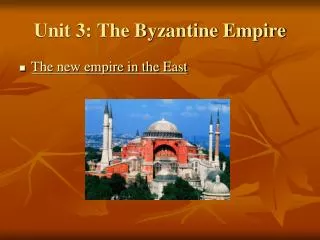
Unit 3: The Byzantine Empire • The new empire in the East
Geography 12:00 geography • Part 2 geography • Constantinople • Location • The Bosporus strait • Trade • Defense • Walls • Moat • Peninsula
The West Language Legal system Religion Education Economy Culture The East Language Legal system Religion Education Economy Culture Latin West vs. the Byzantine East
Economy and Politics • Byzantine Prosperity • Trade (silk) • Weapons (Greek Fire) • The Relationship between church and state • East (Bishop chosen by Emperor) • Emperor seen as “similar to God” in authority and rank • West (Pope chooses HRE)
Justinian and Theodora (527-565) • Justinian's Code • Theodora (wife) • The Hagia Sophia • Conquest of the West • The Stirrup
The Split between East and West • Slow change • Language • Ceremonies / Holy days • Filioque statement • Icons and Iconoclasm • Married clergy • Church and state (reject Papal supremacy) • The Schism of 1054 • Eastern Orthodox Church
The Byzantine Empire Besieged • By 631 had lost back most of the land in the West • Why? • The Emergence of Islam • 717 Muslim Navy repelled by Greek Fire • Slavs and the Seljuk Turks in the 11th Century • The Crusades 1204 4th Crusade conquers city • 1453: Mehmet II and the Ottoman Turks