Download
1 / 6
60 likes | 168 Vues
This article discusses the complex dynamics of mercury methylation in the Salt Lake Valley, highlighting the need for innovative methods to track and quantify mercury sources and transformations. It covers significant findings on the mass-dependent and mass-independent fractionation of mercury, particularly under varying conditions of dissolved organic carbon. The elevated mercury concentrations in brine shrimp and the alarming increase in mercury levels in eared grebes and various duck species during their life cycles are examined, raising concerns about ecological impacts on local organisms.

E N D
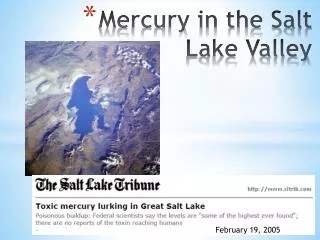
Mercury in the Salt Lake Valley • It’s kind of a big deal February 19, 2005
What is known? USGS, 2000 USGS, 1997
“New approaches are necessary to better elucidate, track, and quantify Hg sources and transformations in the environment” (Bergquist and Blum); especially methylmercury. • Mercury exhibits both mass dependent and mass independent fractionation in ecological pathways though photoreduction is the only mechanism that exhibited significant mass independent fractionation (MIF in MeHg is more pronounced than iHg during photoreduction experiments). • Degree of MIF is greater in large dissolved organic carbon (DOC) conditions • Fractionation may be dependent on the type of DOC (GSL and wetland sediments) Isotopic Signatures
Brine shrimp have been found to have elevated levels of Hg in summer/fall (Naftz, 2008) • Eared grebes Hg concentration increased three-fold over the fall molting period (Naftz, 2008) • Many duck species have exceeded EPA limits (.3 mg/kg Hg dry weight) (Peterson, 2008) • What about other organisms/plants? Affect to organisms
Extension: Mercury in Ecuador Figure from Greg Carling Image from Greg Carling