Download
1 / 17
320 likes | 631 Vues
The Continuously Operating Reference Stations (CORS) network, managed by NOAA's National Geodetic Survey, comprises over 1,900 GPS/GNSS stations across the United States and beyond. This multi-purpose network serves various applications, including geodesy, surveying, meteorology, and monitoring. CORS provides essential data products such as GNSS reference frames and antennas calibration, contributing $1.2 billion in economic benefits to the U.S. as of 2012. The CORS network involves collaboration from federal, state, academic, and private partners, enhancing its impact on multiple domains.

E N D
Continuously Operating Reference Stations (CORS) Neil D. Weston National Geodetic Survey, NOS, NOAA
Outline • Introduction • Continuously Operating Reference Stations • Network • Applications • Products • Selection Criteria • Business Model
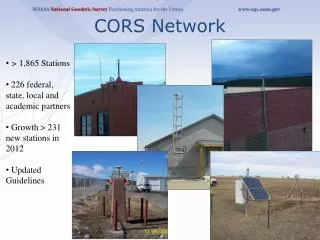
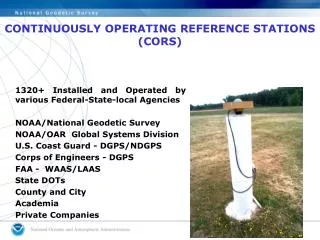
Introduction - CORS • CORS – Nationwide network of GPS/GNSS receivers – 1900+ stations • Multi-purpose, cooperative endeavor • Federal – NOAA, Federal Aviation Administration • State – Departments of Transportation • Academic – Universities • Others – Private • 226 partners • $1.2 Billion in economic benefits for USA -2012
CORS Applications Geodesy / Surveying / Hydrography Meteorology / Space Weather Geophysical applications / Monitoring Geographic Information Systems (GIS/LIS) Mining / Forestry Interference Detection
CORS Products and Activities GNSS (GPS + GLONASS) – Data Reference Frames and Coordinates Station Metadata Online Positioning User Service (OPUS) Antenna Calibration Geoid Modeling Remote Sensing / Photogrammetry Surveying Orbit Production
Antenna Calibrations • Absolute Antenna Calibrations • For use with IGS08, epoch 2005.00 • For use with NAD 83 (2011, MA11, PA11) epoch 2010.00 • Relative Antenna Calibrations • For use with ITRF00, epoch 1997.00 • For use with NAD 83 (CORS96, PACP00, MARP00) epoch 2002.00
GPS Orbits • Ultra-rapid (iguWWWWD.sp3) • 6 hour latency, 24 hour file, sp3 format • Rapid (igrWWWWD.sp3) • 13 hour latency, 24 hour file, sp3 format • Final (igsWWWWD.sp3) • 12 to 14 day latency, 24 hour file, sp3 format
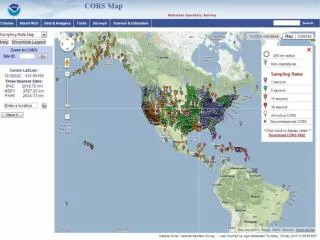
CORS Selection Criteria 70 Km Spacing • Meet and support NOAA mission • Higher density sites – excessive redundancy • NOAA and other federal agency needs • Data quality of nearby CORS • Equipment – receivers and antennas • Collection rate • GNSS / GPS – observations available
Business Model Executive and Agency Summary Continuously Operating Reference Stations (CORS) CORS Products and Services Market Analysis Operational Components Management and Organization Costs and Associated CORS Activities Geodetic Resources External Dependencies
CORS Statistics Data Type 2012 2013 CORS FTP 44,774,666 41,276,983 UFCORS 1,212,604 1,263,519 OPUS 286,599 232,591 OPUS-RS 136,450 129,218
Thank YouDr. Neil D. Westonneil.d.weston@noaa.gov+1 301-713-3169