Colombia: A Detailed Overview of Geography, Demographics, and Political History
Explore the diverse landscapes and rich cultural tapestry of Colombia. This overview delves into Colombia's geography, including the Andes, Atlantic and Pacific Coasts, and the vibrant Amazon region. With a population of 35 million as of 2005, the country is predominantly comprised of Mestizos, Caucasians, Indigenous peoples, and African-Colombians. Discover historical insights into Colombia's political evolution, marked by the struggles between Liberals and Conservatives, the impact of the Great Depression, and the establishment of the National Front.

Colombia: A Detailed Overview of Geography, Demographics, and Political History
E N D
Presentation Transcript
COLOMBIA Introduction
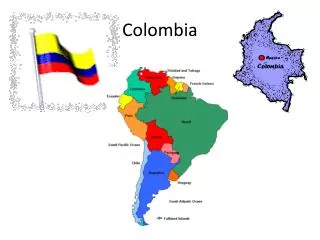
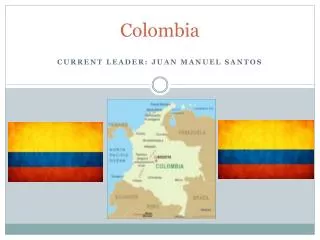
Geography • Regions • Andes • Atlantic Coast • Pacific Coast • Jungle (Leticia Corridor)
People • Population (35 million - 2005) • Ethnicity • Caucasians (relatively more than in other Latin American countries) • Mestizos • Largest demographic group • Predominate in highlands • Indians (highlands and jungle) • Mulattos - African-Colombians • Primarily on the coasts
Other Cities of Colombia • Medellin: industry • Cali: Gateway to the Pacific • Baranquilla: Caribbean commerce • Bucamaranga: vibrant city of the interior
Great Depression gives rise to Liberal hegemony • Historic struggle between Liberals and Conservatives • Pro-clerical • Dominate until the Great Depression • State intervention in economy under Alfonso López Pumarejo • Anti-clerical • Majority party since the Great Depression
Return of the Conservatives1946-53 • 1946 election of Mariano Ospina Pérez (Conservative) • La Violencia begins in 1946 • 14,000 killed in 1947 alone
1948 assassination of Jorge Gaitán leads to Bogotazo • State of siege declared by civilian government • Civilian politicians lose their legitimacy
Dictatorship of Gen. Gustavo Rojas Pinilla 1953-57 • Conservative split • Liberal support for military intervention • July 13, 1953 military Golpe • Progress in pacification
Colombian Military: anti-oligarchy accent takes hold • Amnesty for Communists • Pacification of countryside leads to sympathy for the peasants • Beginnings of military populism • Economic crisis and suspension of credit by World Bank leads to removal
The National Front • Created by Alberto Lleras Camargo (Liberal) and Laureano Gómez (Conservative) • Stipulations • Alternation • Parity in congress, cabinet, governors mayors • No new parties • Merit in lower civil service • Two-thirds majority in congress to pass legislation
Period of National Front Rule • Liberals • Alberto Lleras Camargo (1958-62) • Carlos Lleras Restrepo (1966-70) • Conservatives • Guillermo Leon Valencia (1962-66) • Misael Pistrana Borrero (1970-74)
ANAPO and the End of the National Front • Rojas wins in the cities but official returns claim that he lost • Rojas: aged and in poor health • Acquiesces to defeat • ANAPO institutionalized as a political party • Transfer of leadership to daughter María Eugenia
End of National Front • National Front dissolves in 1974 • Behind the scenes cooperation continues between Liberals and Conservatives