Download
1 / 29
290 likes | 422 Vues
In 480 BC, Xerxes I led 60,000 troops to invade mainland Greece, resulting in significant battles at Thermopylae and Salamis. Despite betrayal causing the fall of Athens, Themistocles' naval forces secured a decisive victory, leading to the eventual Persian defeat at Plataea. This conflict paved the way for Athens' "Golden Age," during which it became a dominant city-state and the center of culture and democracy, influenced by leaders like Pericles. However, internal conflicts led to the Peloponnesian Wars, which marked the decline of Athenian power.

E N D
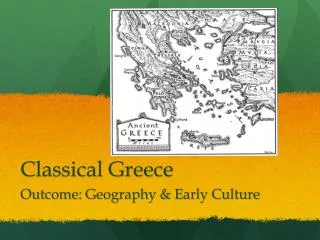
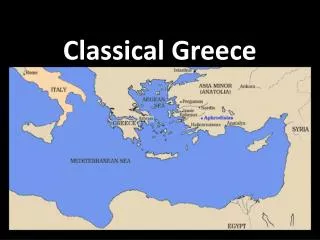
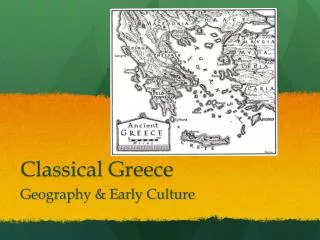
PERSIAN WAR • Xerxes I invades mainland Greece in 480 BC • 60,000 Troops • Medes, Persians, Assyrians, Arabs and Ethiopians • Coalition army lead by the Spartans met with the troops at Thermopylae • They were betrayed and Athens was destroyed • Themistocles and the Greek navy won a critical naval battle near the small island of Salamis • Plataea – critical battle lead by the Spartans • Persian war officially ended 30 years later, but the Persians never came back to Greece.
The “Golden Age” of Pericles • Athens claimed to be the Greek savior and set out to liberate the rest of the country. • Delian League • Formed in 478 BC • Band of city states and Athens who developed a common foreign policy and contributed ships and money when Athens needed it. • Became a highly prosperous Athenian empire. • Athens became the richest Greek city state • Political decisions made by citizen majority • Golden Age lasted less than 50 years. • Pericles dominated Athenian politics from 450-429
Peloponnesian Wars • The Greeks never really existed peacefully. • Athens • Cultural society, democracy, and artistic • Sparta • Old ways, militarism, and oligarchy • Spartans won in 404 • Athens was humiliated • Athens forced to tear down defense systems • Athens put under control of a council of conspirators called the 30 Tyrants • Sparta did not assume cultural leadership and did not have much long-lasting influence.
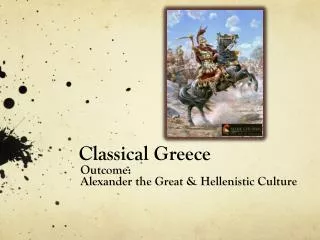
The Hellenistic Age • King Philip II seized the throne of Macedon and allied with the Greeks. Two years later he was assassinated by his own men • Alexander • Pupil of Aristotle • More interested in a world order • Carried Greek culture to Asia • Defeated Darius and took over the Persian Empire • Founded Alexandria • A city BY Greece not a city OF Greece • One of the most influential and important cities in Hellenism • Syncretism – the fusion of diverse religious beliefs and practices • Intercultural relationships blossomed
Concepts • History • Sophistry • Stoicism • Epicureanism • Cynicism • Skepticism • Mystery Cults • Ethics • Aesthetics • Classicism • Hellenism
History • Pre 5th Century = Oral Tradition • More myth than fact • Herodotus = Father of history • Wrote History of the Persian War (9 volumes) • Retained neutral stance • Examined the reliability of his sources • Wanted others to draw their own conclusions • Thucydides • History of the Peloponnesian Wars • Reveals an unbiased compilation that strives to show human motives to draw a larger picture. • Sought to instruct readers so that they would be armed with knowledge when events of the past recurred.
Sophistry • The rise of Sophistic philosophy demonstrated the contemporary concern of humankind, challenging the existence of truth. • Reason had lead to deception • Persuasion and Practicality • Debating and rhetoric skills became necessary • Sophists – those who used the art of persuasion, rhetoric, grammar, diction and logical argument. • Protagoras • Sophist who believed that man is the measure of all things. • What seems true for one may not be true for another. • Truth is relative
Stoicism • Founded by Zeno • Humans are the incarnation of reason which produces and directs the world. • The good life follows reason, wisdom and virtue, but the only way to achieve these goals is to renounce and accept simplicity. • Leave everything to God and accept whatever happens. • Approach life with apathy • Happiness is the ultimate goal • The senses are important in understanding underlying moral law and the divine plane for the world. • Took an optimistic viewpoint
Epicureanism • Founded by Epicurus • Life of strict quietude • Humans consisted of a temporary arrangement of atoms that dissolved at death. • Because it was temporary the good life was an untroubled life. • Avoid entanglements, maintain good health, tolerate pain, and accept death without fear • The senses could be relied upon to give an accurate picture of reality and the mind functioned as a storehouse for those observations
Cynicism • Humans are animals • Good life is about having animalistic needs met • Needs are troublesome and a wise person will have as few needs as possible. • If a person wanted nothing he needed nothing • “Society” kept them from pursuing freedom and independence • Isolated themselves • Had little appeal to the masses or aristocracy
Skepticism • Founded by Pyrrho of Elis • Nothing was certain – Universal Doubt • The senses were completely unreliable as sources of knowledge. • The only certainty = “Truth is unattainable” • Everything in life is relative • Even less popular than Cynicism
Mystery Cults • Hellenistic times were uncertain times • People developed a belief that fate will do whatever fate wants to do. • People developed pietistic religious beliefs • Emotionalism takes the place of intellectualism or rationalism. • Cult of Dionysus • God of revelry and wine • Serapis • New god invented by Ptolemy I to unite Egyptians and Greeks • Cult of Isis • One of the most antagonist forces met by early Christians • Emphasized resurrection after death, which put it in direct conflict with Christianity. • Appeal probably lies in the mystery of the cult • Secret initiation rites gave the member a special status
Ethics • The general nature of morals and of the specific moral choices to be made by the individual in relationship with others. • Socrates = father of ethics • Condemned the Sophists for their lack of belief in a universal moral order. • Called on others to examine their own lives • Psyche = the mind or soul • Immortal and much more important than the body • Everyone had a responsibility to raise his/her psyche to the highest level possible • Knowledge created virtuous behavior • If you were evil it was because of your lack of knowledge
Aesthetics • Plato = inventor of aesthetics • The study of the nature of beauty • Art derived from Techne • The skill of knowledge and making • The ability of an artist to command a medium, to know what the end result would be, and to know how to execute the artwork to achieve the results • Fundamental principles = Proportion and Measure • Forms and Ideas are reality • Everything on earth imitates reality • Ideas are not thoughts of an individual human or divine mind, they are the objects of thought • They exist independently and we think of them no matter what • The arts are practiced to create imitations of forms • Plato mistrusted the arts because the individual artist may fail to understand the ultimate reality. • The artist must have artistic inspiration
Aristotle • Teacher of Alexander the Great • Set up the Lyceum (school) • Writings on nature make him the first real scientist. • All arts imitate nature. • Classicism • Fundamentals: elements of composition must display symmetry, harmony, and definition • Differs from Plato (artistic imitation fuels passions and misleads the seeker of truth) • Aristotle believed that the arts repair deficiencies in nature and makes a moral contribution. • Rejects Plato's vie of the centrality of beauty and of metaphysical idealism. • He agrees with Plato that art is a kind of Techne • The purpose of art is to give pleasure
Classicism VS Hellenism • Classicism • Artistic style and cultural perspective based on principles associated with the art and thought of ancient Greece and Rome. • Striving for harmony, order, reason, intellect, objectivity, and formal discipline. • Represent idealized perfection rather than real life • Hellenism • Anti-Classical principles • Moving toward reflections of emotions and naturalistic (NOT Idyllic) depictions.
Painting • Classical Style • New idealization in figure depiction • Stereotype vs real person • Foreshortening issues were fixed • Figures have a new sense of depth • Vase painting still an important source of art • Four Characteristics of Classical Style Vase Painting • Portrayal of figures in simple line drawings • Monochromatic color scheme • Palette dependent on earthen tones (red) • Heroic and idealized subject matter continually changed • Began spacing figures higher than others rather thank keeping them on a single base line
Sculpture • Greek Classical Style sculpture continually changed. • One artist’s work was very different than others • Greek philosophy reflect the idealized, vigorous, youthful bodies that exhibit self control and physical perfection • Weight shift • moving away from absolute symmetry • Contropposto – weight shift onto one leg • Myron • The Discus Thrower • Increasing vitality of figure movement (frozen pose of movement) • Polyclitus • Developed a set of rules for constructing the ideal human figure
Late Classical Sculpture • Greater emphasis on motion • Praxiteles • Cnidian Aphrodite • Lysippus • Scraper
Hellenistic Sculpture • Increasing interest in the differences between individual humans • Turned away from idealism toward sorrow or flights of technical vertuosity. • Powerful emotion, often tragic as if acting out a drama on stage • Winged Victory – Nike of Samothrace • Laocoon and his Two Sons • Dying Gaul
Classical Architecture • Doric Order • Ancient origins • Used in Classical Greece • Ionic Order • Classical Greek column • Volutes • Corinthean Order • Hellenistic style column with Greek elements