Entity Relationship
This article delves into Entity-Relationship (ER) diagrams, which visually depict the interrelations between entities in a database. We explore the different symbols used: boxes for entities, diamonds for relationships, and ovals for attributes. Additionally, we describe the three main types of relationships: one-to-one, one-to-many, and many-to-many, illustrating how they are integral to database design. Gain clarity on how these relationships work and enhance your database modeling skills.

Entity Relationship
E N D
Presentation Transcript
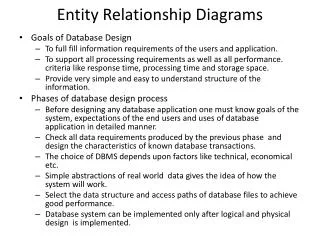
Entity Relationship Diagrams and symbols
What is an Entity Relationship? • An entity-relationship (ER) diagram is a specialized graphic that illustrates the interrelationships between entities in a database. ER diagrams often use symbols to represent three different types of information. Boxes are commonly used to represent entities. Diamonds are normally used to represent relationships and ovals are used to represent attributes.
Symbols used in E.R.D Boxes are commonly used to represent entities. Diamonds are normally used to represent relationships Ovals are used to represent attributes.
One –one Relationship • One-to-one relationships occur when there is exactly one record in the first table that corresponds to exactly one record in the related table. In rare cases a one-to-one relationship is modelled using two database tables. Such a setup is sometimes used to overcome the limitations of a database system or to gain performance. This way of modelling a one-to-one relationship should be avoided.
One-Many Relationship • One-to-many relationships occur when each record in TableA may have many linked records in TableB but each record in TableB may have only one corresponding record in TableA. • In a one to many relationship each row in the related to table can be related to many rows in the relating table. This allowed frequently used information to be saved only once in a table and referenced many times in all other tables.
Many-many Relationship • Many-to-many relationships occur when each record in TableA may have many linked records in TableB and vice-versa.
DONE BY: • DERRICKA SEARCHWELL • 6BH • YAY MEEEEE!!!!!!!!!!!!!!