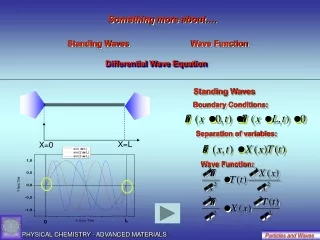
Exploring Standing Waves: Understanding Interference of Opposite Traveling Waves
Discover the fascinating world of standing waves through our interactive Bell Wave Machine animation. This resource demonstrates how two identical waves traveling in opposite directions interfere with one another to create a standing wave pattern. Learn about key concepts such as nodes and antinodes, the relationship between the number of nodes and wavelengths, and how the spacing between nodes is equal to ½λ. Join us on this journey to visualize and understand the principles of wave interference over time!

Exploring Standing Waves: Understanding Interference of Opposite Traveling Waves
E N D
Presentation Transcript
Standing Waves Interference Over Time
Key Question What would two identical waves, travelling in opposite directions look like when they interfere with each other?
Let’s See!!! • Bell Wave Machine • Animation http://www.walter-fendt.de/ph14e/stwaverefl.htm
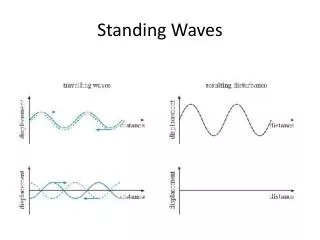
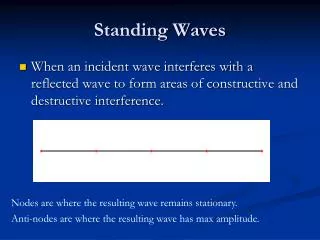
A standing wave pattern is the result of the interference between two identical waves travelling in opposite directions
How many wavelengths does each standing wave have? • What is the relationship between number of nodes and wavelength? • Copy down the board note
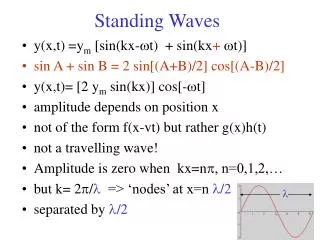
Labelling a Standing Wave Nodal points or Nodes (N) • points in a standing wave pattern that remain at rest • Spacing between nodes is equal to ½λ • Complete destructive interference
Labelling a Standing Wave Antinodes • points where constructive interference occurs creating double crests and double troughs