Enhancing Productivity through Agility: Strategies for Complexity Reduction and Collaboration
In today's fast-paced business environment, organizations must reduce complexity, increase agility, and improve collaboration to thrive. By leveraging automation and implementing model-based systems engineering, productivity can dramatically increase. Our analysis reveals that productivity improvements can range from 5% to 100%, depending on the implementation timeframe and associated costs. Emphasizing automated processes like testing and change management, organizations can streamline their operations, enhance team dynamics, and overcome challenges related to legacy systems and regulatory constraints.

Enhancing Productivity through Agility: Strategies for Complexity Reduction and Collaboration
E N D
Presentation Transcript
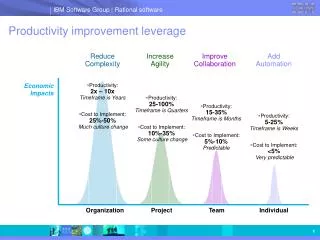
( Agility ) Reduce Complexity IncreaseAgility ImproveCollaboration Add Automation = ( ) Resources Complexity ( Collaboration ) ( Automation ) * * * * Economic Impacts • Productivity:2x – 10xTimeframe is Years • Cost to Implement:25%-50% Much culture change • Productivity:25-100%Timeframe is Quarters • Cost to Implement:10%-35% Some culture change • Productivity:15-35%Timeframe is Months • Cost to Implement: 5%-10%Predictable • Productivity:5-25%Timeframe is Weeks • Cost to Implement:<5% Very predictable Organization Project Team Individual Productivity improvement leverage
Model-Based System Engineering Leverage Reduce Complexity IncreaseAgility ImproveCollaboration Add Automation • Measured trends • Reduced cycle time from model to code • Change management • Automated instrumentation • Automated testing • Automated traceability • Automated change propagation • Feature anatomy • Reusable assets • Simplify views • Separate concerns • Integrate behaviors • Semantically rich representations • Consistent language • In-context review Opportunities • Regulatory constraints • Procurement inertia • Platform integration • Security assessment • Systems growth • Reuse governance • Legacy architectures and assets • Team distribution • Buyer-customer inclusion Challenges