Understanding Succession and Plant Reproduction: A Comprehensive Overview
This document explores ecological succession, distinguishing between primary and secondary succession processes. Primary succession occurs on bare rock, starting with pioneer species like lichens and mosses, leading to climax communities such as maple-beech forests. Secondary succession, triggered by disturbances like fires or floods, involves faster transformation of an ecosystem. Additionally, it covers asexual and sexual reproduction in seed plants, including mechanisms like vegetative reproduction and pollination strategies, highlighting gymnosperms and angiosperms' distinct reproductive structures.


Understanding Succession and Plant Reproduction: A Comprehensive Overview
E N D
Presentation Transcript
13.1 Succession Pages 588-591
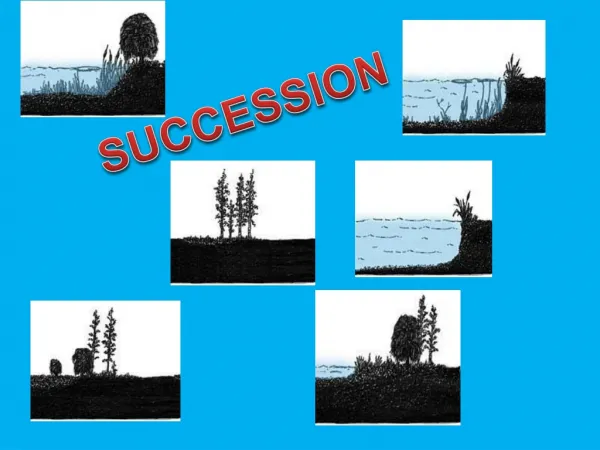
Succession • The gradual change in types of species found in an area over time.
Primary Succession • Begins on bare rock Examples: after glaciers recede, volcanoes spew dust and lava or after explosions. Pioneer plants are first colonizers
Primary succession • Bare rock
Primary Succession • Lichens (fungi and algae)
Primary Succession • Grass and wild flowers
Primary Succession • Shrubs
Primary Succession • trees
Primary succession • Climax forest: Maple beech forest
Secondary Succession • Occurs after a disruption Examples include fire, flood, storms, plowing or digging the ground • Faster transformation
Secondary Succession • construction
Secondary succession • Forest fire
Secondary Succession • floods
13.2 Asexual Reproduction in Seed Plants Pages 592-594
Vegetative reproduction Leaves
Asexual reproduction Stems -rhizomes -corms -stolons -tuber “eyes”
Asexual Reproduction Roots -suckers
pros and cons Advantages: -less energy investment -quick -plantlets are more robust than seedlings Disadvantages: -lack of genetic variation
Grafting branch is attached to a stem of another plant • Branch is the scion. • Donor plant is the stock.
13.3 Sexual Reproduction in Plants Pages 595-602
Seed-protects and nourishes the embryo Endosperm-specialized nutritive layer
Seeds • Seed dispersal by wind, water, animals • Gymnosperms are naked seeds • Angiosperm seeds are contained in fruits
Benefits of Sexual reproduction -Genetic variety -Wide dispersal -Seed dormancy
Gymnosperms • Male cones microspores pollen grains • Female cones megaspores egg-producing gametophytes • Wind pollination
Fertilization • Pollen grain lands next to ovule. • Pollen tube grows to ovule. • Haploid nucleus divides into two haploid sperm. • One sperm fertilizes ovule • Time: 13 months
Angiosperms Male: stamen Female: carpel
Parts • Male: stamen anther –pollen grains filament- stalk • Female: carpel stigma- sticky top style- stalk ovary- contains ovules
Monocot vsEudicot flowers • Monocot flowers- petals in 3’s Ex. tulip, lilly • Eudicot flowers – petals in 4’s or 5’s or more Ex. rose
Pollination • Animal or wind • Cross-pollination between plants • Self-pollination between flowers Pollen lands on stigma Pollen tube grows down to ovary 2 haploid sperm: one fertilizes ovule to make a 2n seed, and one fertilizes a diploid polar nuclei that becomes a triploid 3n endosperm