Exploring Scanning Tunneling Microscopes: Scans, Schematic, and Scientific Inquiry
This activity, developed by Malory M. Peterson under the Nanotechnology Grant from the National Science Foundation, guides students through the fundamental concepts of Scanning Tunneling Microscopes (STM). Participants will familiarize themselves with STM components, create a schematic, and conduct scans to analyze molecular structures. The activity encourages critical thinking through questions on nanotechnology, heat effects on scanning, and observational techniques. Perfect for hands-on learning, this resource promotes engagement in nanotechnology and microscopy.

Exploring Scanning Tunneling Microscopes: Scans, Schematic, and Scientific Inquiry
E N D
Presentation Transcript
STM Scanning Tunneling Microscope Viewing Scans and Questions (Activity) Developed by Malory M. Peterson, Summer 2006 Nanotechnology Grant National Science Foundation #0532516
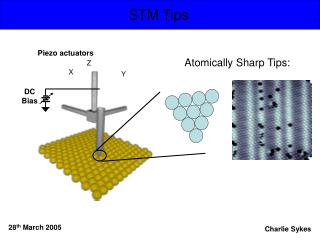
Becoming Familiar With the STM • Start by checking out the STM and identifying the different parts of the machine. • Tip • Controller • Sample • Sample Holder • On your worksheet, Draw a schematic of how the STM works. Make sure you understand your schematic.
Scans • Look at the large scans (400 nm – 500 nm) and locate level areas. • Zoom in • Review the smaller scan area (2 nm – 4 nm) and draw a picture on your worksheet of what the scan looks like. • Identify a molecule, if you can, and estimate its size. • Do not forget to label the axis in your drawing.
Additional Questions • What does nanotechnology mean? • What is the purpose of the air bags and sand on the STM cart? • Remembering that heat makes particles excited; would it be easier or harder to scan at higher temperatures? Why? • Why does the STM tip have to be as sharp as possible (ideally, the size of a single atom)? • What are two ways we “see” the layers in the HOPG. • What do the letters in STM stand for? • How does “indirect observation” relate to the STM?