Understanding Human Development Index: Insights on Economic Growth and Population Dynamics
The Human Development Index (HDI) forecasts a country's economic growth by assessing life expectancy, literacy rates, and average income levels. It categorizes nations on a scale from 1 to 100, offering insights into human development. Countries scoring 0-50 indicate low development, 51-80 suggest medium development, while scores of 81-100 reflect high development. Geographic factors such as political boundaries, climatic regions, topography, and natural hazards significantly influence HDI outcomes, resource distribution, business activities, and cultural dynamics.

Understanding Human Development Index: Insights on Economic Growth and Population Dynamics
E N D
Presentation Transcript
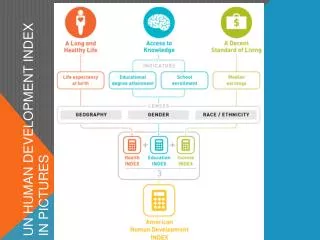
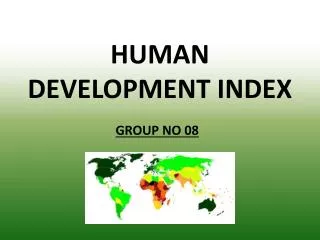
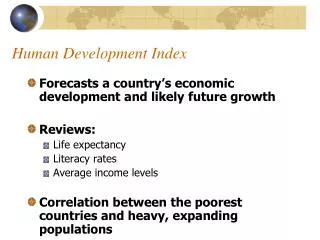
Human Development Index • Forecasts a country’s economic development and likely future growth • Reviews: • Life expectancy • Literacy rates • Average income levels • Correlation between the poorest countries and heavy, expanding populations
Scoring for Human Development Index • Scaled from 1 – 100 • Countries scoring 0 – 50 equate to a low human development population • Countries scoring 5 – 80 equate to a medium development population • Countries scoring 80 – 100 equate to a high human development population
Geographic Factors Influencing IB • Political boundaries • HDI • Climatic Regions • Topography • World Natural Hazards • Land Use • Population • Time Zones • Climates
Time Zones • Importance relating to resources • Importance relating to business activities • Importance relating to culture