Cartesian Schemes Combined with a Cut-Cell Method, Evaluated with Richardson Extrapolation
340 likes | 523 Vues
This study presents an innovative approach to computational aeroacoustics by combining Cartesian schemes with a cut-cell method, evaluated using Richardson extrapolation. We discuss spatial discretization, time integration, and test cases involving linearized Euler equations, focusing on the sound modeled as inviscid fluid phenomena. Key findings on order of accuracy and the impact of boundary conditions are highlighted. The effectiveness and optimization of these computational methods provide insights into their application for modeling acoustic waves and their disturbances in various scenarios.


Cartesian Schemes Combined with a Cut-Cell Method, Evaluated with Richardson Extrapolation
E N D
Presentation Transcript
Cartesian Schemes Combined with a Cut-Cell Method, Evaluated with Richardson Extrapolation D.N. Vedder Prof. Dr. Ir. P. Wesseling Dr. Ir. C.Vuik Prof. W. Shyy
Overview • Computational AeroAcoustics • Spatial discretization • Time integration • Cut-Cell method • Testcase • Richardson extrapolation • Interpolation • Results • Conclusions
Computational AeroAcousticsAcoustics • Sound modelled as an inviscid fluid phenomena Euler equations • Acoustic waves are small disturbances Linearized Euler equations:
Computational AeroAcousticsDispersion relation • A relation between angular frequency and wavenumber. • Easily determined by Fourier transforms
Spatial discretization OPC • Optimized-Prefactored-Compact scheme • Compact scheme Fourier transforms and Taylor series xj-2 xj-1 xj xj+1 xj+2
Spatial discretization OPC • Taylor series Fourth order gives two equations, this leaves one free parameter.
Spatial discretization OPC • Fourier transforms Theorems:
Spatial discretization OPC Optimization over free parameter:
Spatial discretization OPC 2. Prefactored compact scheme Determined by
Spatial discretization OPC 3. Equivalent with compact scheme Advantages: 1. Tridiagonal system two bidiagonal systems (upper and lower triangular) 2. Stencil needs less points
Spatial discretization OPC • Dispersive properties:
Time Integration LDDRK • Low-Dissipation-and-Dispersion Runge-Kutta scheme
Time Integration LDDRK • Taylor series • Fourier transforms • Optimization • Alternating schemes
Time Integration LDDRK Dissipative and dispersive properties:
Cut-Cell Method • Cartesian grid • Boundary implementation • Cut-cell method: • Cut cells can be merged • Cut cells can be independent
Cut-Cell Method fn fe fw • fn and fw with boundary stencils • fint with boundary condition • fsw and fe with interpolation polynomials which preserve 4th order of accuracy. (Using neighboring points) fint fsw
Testcase Reflection on a solid wall • Linearized Euler equations • Outflow boundary conditions • 6/4 OPC and 4-6-LDDRK
Results Pressure contours The derived order of accuracy is 4. What is the order of accuracy in practice? What is the impact of the cut-cell method?
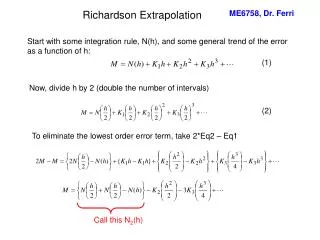
Richardson extrapolation Determining the order of accuracy Assumption:
Richardson extrapolation Three numerical solutions needed Pointwise approach interpolation to a common grid needed
Interpolation Interpolation polynomial: Fifth degree in x and y 36 points • Lagrange interpolation in interior • 6x6 squares • Matrix interpolation near wall • Row Scaling • Shifting interpolation procedure • Using wall condition 6th order interpolation method, tested by analytical testcase
Results Solution at t = 4.2 Order of accuracy at t = 4.2
Results (cont)Impact of boundary condition and filter • Boundary condition • Filter for removing high frequency noise
Results (cont) Order of accuracy t = 8.4 t = 4.2
Results (cont)Impact of outflow condition • Outflow boundary condition • Replace by solid wall
Results (cont)Impact of cut-cell method Order of accuracy t = 8.4 t = 12.6 Solid wall
Results (cont)Impact of cut-cell method fn fe fw • Interpolation method used for and • Tested by analytical testcase • Results obtained with three norms • Order of accuracy about 0!! fsw fe fint fsw
Conclusions • Interpolation to common grid • 6th order to preserve accuracy of numerical solution • Impact of discontinuities and filter • Negative impact on order of accuracy • Impact of outflow boundary conditions • Can handle waves from only one direction • Impact of cut-cell method • Lower order of accuracy due to interpolation • Richardson extrapolation • Only for “smooth” problems