Conversions using Unit Rates
This guide explores the importance of unit conversions in various scientific fields, illustrated by the Mars Climate Orbiter mission failure due to incorrect unit translations. Learn how to identify starting and ending units, align conversion factors, and ensure accurate calculations. Step-by-step examples for converting distances (meters to kilometers), weights (grams to kilograms), and volumes (liters to gallons) will be provided. Enhance your mathematical skills and ensure precision in measurements, as demonstrated by the lessons from space missions.


Conversions using Unit Rates
E N D
Presentation Transcript
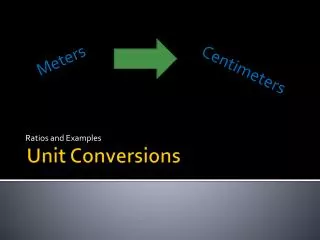
meters grams litres Converting Units kilometres centimetres kilograms Joanne Smithies Our Lady & St. Gerards RCP
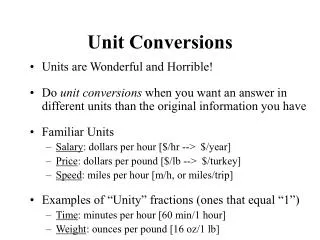
Are Units important? "The 'root cause' of the loss of the spacecraft was the failed translation of English units into metric units in a segment of ground-based, navigation-related mission software, as NASA has previously announced," said Arthur Stephenson, chairman of the Mars Climate Orbiter Mission Failure Investigation Board. "The failure review board has identified other significant factors that allowed this error to be born, and then let it linger and propagate to the point where it resulted in a major error in our understanding of the spacecraft's path as it approached Mars." http://mars.jpl.nasa.gov/msp98/orbiter/ 4
Steps: 1. Identify starting & ending units. 2. Line up conversion factors so units cancel. 3. Multiply all top numbers & divide by each bottom number. 4. Check units & answer.
Use your unit rates to convert. • 60 in = ______ ft • 5 yd = ______ ft • 30 ft = ______ yd
Use your unit rates to convert. • 4 C = ______ oz • 12qt= ______ gal • 8pt= ______ C
Use your unit rates to convert. • 6 lb= ______ oz • 8,000 lbs= ______ T • 144 oz= ______ lbs
Use your unit rates to convert. • 50 mm = ______ cm • 7,000 m= ______ km • 300 cm= ______ m