SlideServe
Menu
Préférences
© SlideServe · v2026

DNA and DNA Replication

labernathy avatar
37 diapositives · 439 Views · Jan 02, 2020

Learn about the discovery of DNA by Friedrich Miescher, its significance as the "Blue Print of Life," the structure of DNA, replication process, and biotechnological applications such as PCR. Understand key concepts like Base Pair Rule, Histones, and Enzymes involved in DNA replication.
DNA and DNA Replication - slide 1
01 / 37DNA and DNA Replication
1 / 17

Télécharger la présentation

DNA and DNA Replication
Une image / un lien ci-dessous est fourni (tel quel) pour télécharger la présentation

Politique de téléchargement : le contenu du site vous est fourni TEL QUEL pour votre information et votre usage personnel ; il ne peut être vendu, concédé sous licence ni partagé sur d’autres sites sans l’accord de son auteur.Le contenu vous est fourni TEL QUEL, pour votre information et votre usage personnel uniquement. Téléchargez la présentation en cliquant sur ce lien. Lors du téléchargement, si vous ne parvenez pas à télécharger une présentation, l’éditeur a peut-être supprimé le fichier de son serveur.Pendant le téléchargement, si vous ne parvenez pas à obtenir une présentation, le fichier a peut-être été supprimé par l’éditeur.

F I N

Plus de contenu associé

Transcription de la présentation
  1. DNA and DNA Replication

  2. Discovery of DNA an ACCIDENT • Friedrich Miescher was working with white blood cells. • He began gathering pus from the bandages of patients from a local hospital. • After using a salt solution to wash the pus from the bandages, and using an alkaline solution, the nucleus from those white blood cells were obtained.

  3. DNA (Deoxyribonucleic Acid) Why is DNA called the “Blue Print of Life”? It has all the instructions the cell needs to make protein, organelles, carry out chemical reactions and to survive

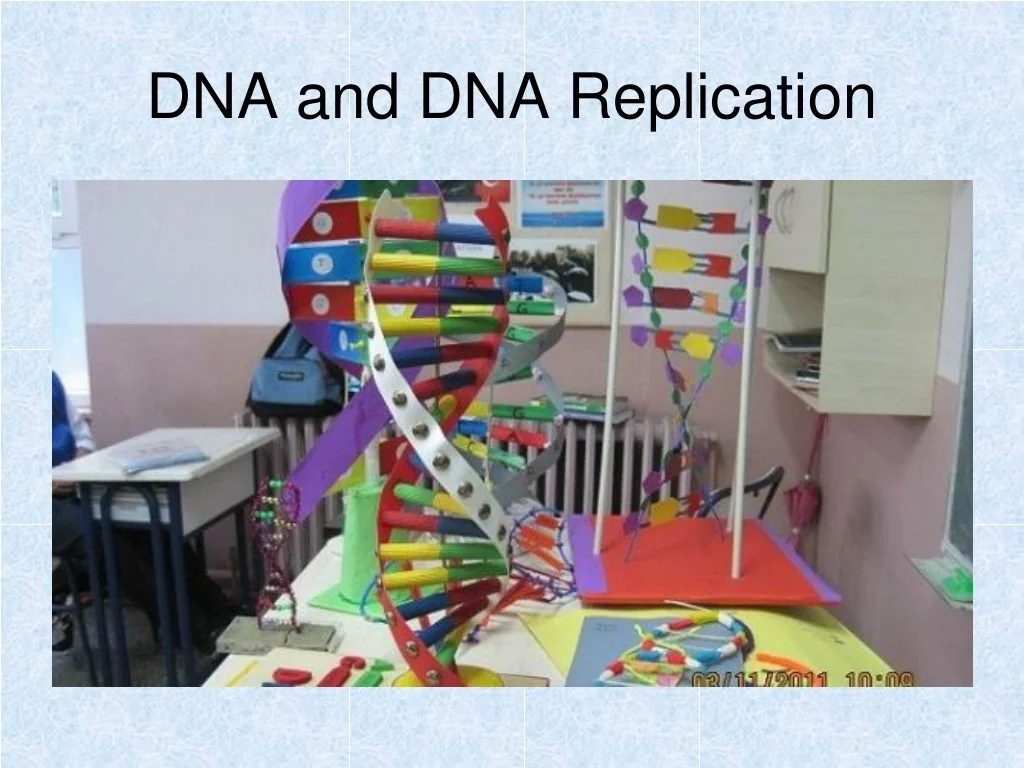
  4. DNA – double helix shape Like a spiral staircase.

  5. What is the backbone of DNA? Phosphate and sugar

  6. Watson and Crick Famous photograph of two young men given credit for discovering the shape of the DNA molecule as a double helix. BUT!

  7. Here are the actual facts!

  8. Rosaline Franklin – knew the shape of DNA before others.

  9. Base Pair Rule in DNA

  10. 1. Name the bond • between the • Nitrogen bases. • If the DNA unzips • where will it • unzip at?

  11. The Building Block or monomer of Nucleic Acids Nucleotide

  12. DNA Template (pattern)

  13. DNA in Prokaryote and Eukaryote Cells

  14. Real photograph of bacterial (Prokaryote) DNA

  15. Bacterial DNA looked at with TEM 1,000,000 X

  16. DNA in Eukaryote Cell

  17. Eukaryote Cell

  18. What are function of Histones?

  19. Chromatin into Chromosome

  20. DNA Replication is the biological process of producing two identical copies of DNA from one original DNA molecule.

  21. Why does DNA need to replicate? • So when the cell divides (mitosis) each new cell will have a complete copy of instructions (DNA). 2. First step in protein synthesis. (when DNA unzips so mRNA can get code) 3. DNA replication occurs in all living organisms and is the basis for biological inheritance.

  22. When does DNA replication occur? • 1. During what phase of the • Cell cycle does DNA • Replication occur? • Does DNA replication • happen (during or before) • mitosis?

  23. DNA Replication (copying itself)

  24. Explain the following Cartoon!

  25. Enzymes involved in DNA replication? • Replication requires enzymes: 1) Helicase – unwinds DNA 2) DNA polymerase – puts new nucleotides in place & proofreads

  26. The process of DNA replication • DNA unwinds & unzips, using Helicase • Replication fork forms, (area where 2 strands separate) * There can be several replication forks at the same time. 3) DNA polymerase adds new nucleotides to each DNA strand!

  27. Biotechnology

  28. DNA Replication in vitro (artificially, outside a cell). • The process is called PCR (polymerase chain reaction) and is used in molecular biology to amplify a single copy of DNA into millions of copies of the same DNA sequence.

  29. PCR Machine (Polymerase Chain Reaction) Technology developed for Biotechnology! (DNA replication out side of a cell)

  30. (DNA Coping itself)

  31. PCR Process using Blood