Distinguishing Prokaryotic and Eukaryotic Cells Through Staining Techniques
A lab technician must identify test tube cells as prokaryotic or eukaryotic using appropriate dyes. Among several options, Nile Blue is selected, as it specifically stains nuclei, a feature unique to eukaryotic cells. This distinction is crucial as it highlights the differences between unicellular and multicellular organisms, emphasizing their structure and function. Unicellular organisms like bacteria and protists perform all life processes in one cell, while multicellular organisms rely on specialized cells for various functions, showcasing the importance of cellular diversity.

Distinguishing Prokaryotic and Eukaryotic Cells Through Staining Techniques
E N D
Presentation Transcript
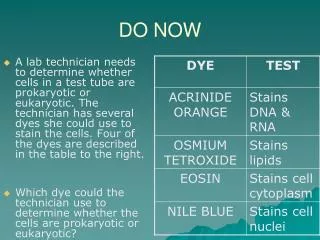
DO NOW A lab technician needs to determine whether cells in a test tube are prokaryotic or eukaryotic. The technician has several dyes she could use to stain the cells. Four of the dyes are described in the table to the right. Which dye could the technician use to determine whether the cells are prokaryotic or eukaryotic?
Answer: Nile Blue Only eukaryotic cells have a nucleus. All of the other tests (DNA & RNA, cytoplasm and lipids) are characteristics shared by pro- and eukaryotes.
Diversity of Cells Objective: 1) To compare Unicellular and Multicellular organisms
I. Organisms may be: A. Unicellular organisms 1. 1 cell big B. Multicellular organisms 1. More than 1 cell 2. Cells may be organized into tissues, organs and systems
II. Unicellular Organisms A. Bacteria, protists, some algae B. One cell is responsible for entire work of keeping the organism alive 1. Hunt or make food 2. Breathe 3. Get rid of waste 4. Defense 5. Movement
2. Euglena 1. Paramecium 3. Amoeba C. Examples:
III. Unicellular organisms have specialized structures: A. Movement: 1. Flagella 2. Cilia 3. Pseudopods B. Contractile vacuoles – pump out water C. Method of eating – oral groove
IV. Multicellular Organisms A. In most, cells are specialized to do a specific job 1. Red Blood Cells carry oxygen 2. Muscle cells contract, allow for movement B. These cells work together/rely on each other for survival 1. If RBC don’t carry oxygen to muscles, muscles can’t move c. Division of labor
V. Colonial Organisms A. Unicellular organisms that live in groups B. Attached to each other but have few specialized structures C. Bridge between uni and multicellular