DECAM NEO Survey: Discovering Near-Earth Asteroids with Advanced Technology
130 likes | 286 Vues
The DECAM NEO Survey, conducted over 30 nights across three semesters starting in 2014, employed the 4m Blanco telescope at CTIO and the Dark Energy Camera (DECam) to identify Near-Earth Objects (NEOs). With a 3 square degree field of view and advanced detection algorithms, we succeeded in linking moving objects through multiple detection techniques, generating preliminary orbital elements for approximately 8,000 detected objects. Results indicate that around 50% of NEOs detected are smaller than 250 meters, highlighting the success of this survey in tracking potentially hazardous asteroids.


DECAM NEO Survey: Discovering Near-Earth Asteroids with Advanced Technology
E N D
Presentation Transcript
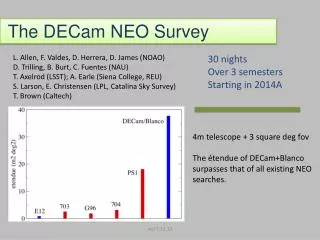
The DECam NEO Survey L. Allen, F. Valdes, D. Herrera, D. James (NOAO) D. Trilling, B. Burt, C. Fuentes (NAU) T. Axelrod (LSST); A. Earle (Siena College, REU) S. Larson, E. Christensen (LPL, Catalina Sky Survey) T. Brown (Caltech) 30 nights Over 3 semesters Starting in 2014A 4m telescope + 3 square deg fov The étendue of DECam+Blanco surpasses that of all existing NEO searches. reu 7.31.13
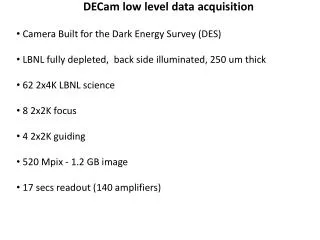
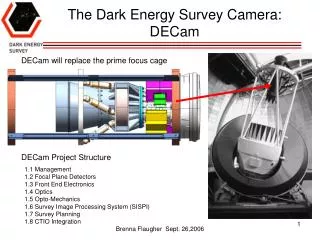
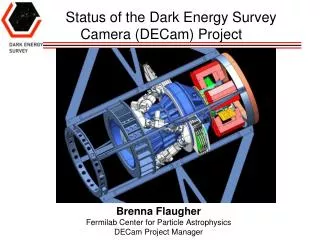
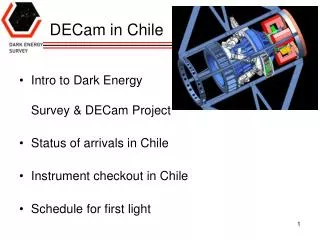
DECam (Dark Energy Camera) 62, 2048x4096 CCDs (520 Megapixels) 3 square degree fov (2.2 degree diameter) reu 7.31.13
The Blanco 4m telescope at CTIO reu 7.31.13
Observing with DECam January 2013 reu 7.31.13
DECam NEO pilot project 4 half-nights in January 4 full nights in April 4 full nights in May (lost) Simulations prepared by REU student Alissa Earle (Siena College) reu 7.31.13
DECam NEO pilot project Moving Object Processing System (MOPS) • Multiple detections intra-night == tracklets • Multiple detections inter-night == tracks MOPS installed on NAU cluster by Jonathan Myers (LSST, U of A) reu 7.31.13
tracks MOPS: Require 3 detections / night == tracklets Require detections on 3 nights == tracks Burt et al. 2013: The Dark Energy Camera Near Earth Asteroid survey: Simulations and object linking, PDC Flagstaff reu 7.31.13
tracks MOPS: Require 3 detections / night == tracklets Require detections on 3 nights == tracks Burt et al. 2013: The Dark Energy Camera Near Earth Asteroid survey: Simulations and object linking, PDC Flagstaff reu 7.31.13
orbital elements (preliminary!) e, i for ~8000 moving objects detected in January and April 2013 q < 1.3 = NEO; ~ 1% of moving objects reu 7.31.13
size distribution (preliminary!) 50% of NEOs detected are smaller than 250 m reu 7.31.13
results – PHAs(preliminary!) MOID == Minimum Orbital Intersection Distance reu 7.31.13