SlideServe
Menu
Préférences
© SlideServe · v2026

Simulation and Physics Studies - Overview

lali avatar
3 diapositives · 144 Views · Sep 17, 2014

Development of high-level reconstruction tools focusing on C++ package and physics channel evaluation for vertex detector. Current status includes coding, validation, and integration work. International collaboration to enhance simulation and tracking tools.
Simulation and Physics Studies - Overview - slide 1
01 / 3Simulation and Physics Studies - Overview
1 / 17

Télécharger la présentation

Simulation and Physics Studies - Overview
Une image / un lien ci-dessous est fourni (tel quel) pour télécharger la présentation

Politique de téléchargement : le contenu du site vous est fourni TEL QUEL pour votre information et votre usage personnel ; il ne peut être vendu, concédé sous licence ni partagé sur d’autres sites sans l’accord de son auteur.Le contenu vous est fourni TEL QUEL, pour votre information et votre usage personnel uniquement. Téléchargez la présentation en cliquant sur ce lien. Lors du téléchargement, si vous ne parvenez pas à télécharger une présentation, l’éditeur a peut-être supprimé le fichier de son serveur.Pendant le téléchargement, si vous ne parvenez pas à obtenir une présentation, le fichier a peut-être été supprimé par l’éditeur.

F I N

Plus de contenu associé

Transcription de la présentation
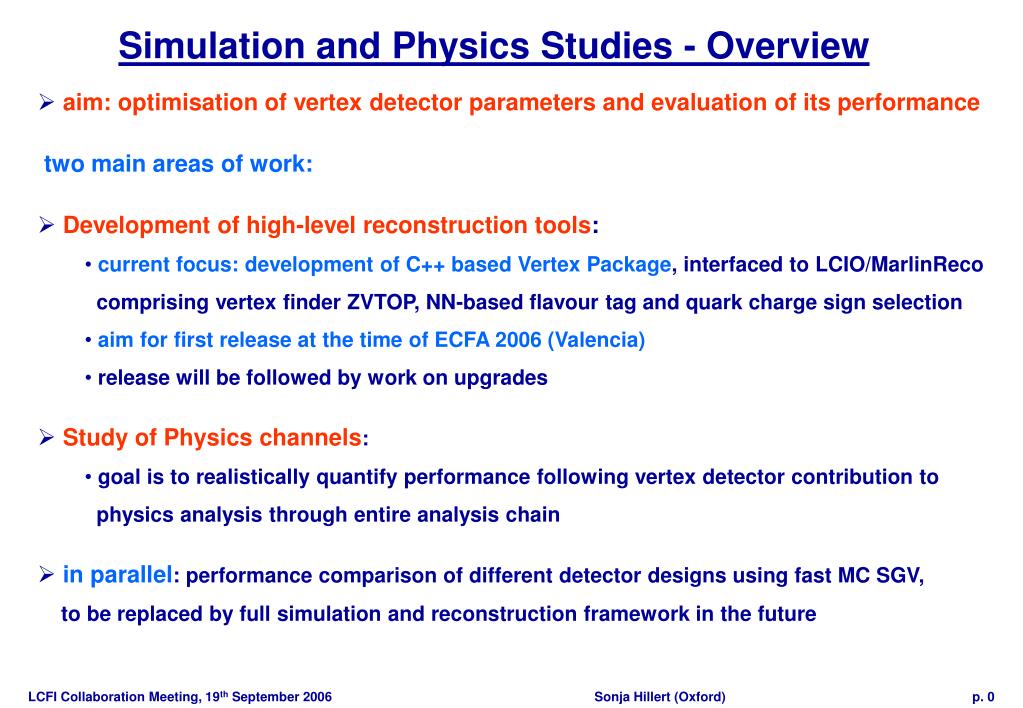
  1. Simulation and Physics Studies - Overview • aim: optimisation of vertex detector parameters and evaluation of its performance • two main areas of work: • Development of high-level reconstruction tools: • current focus: development of C++ based Vertex Package, interfaced to LCIO/MarlinReco comprising vertex finder ZVTOP, NN-based flavour tag and quark charge sign selection • aim for first release at the time of ECFA 2006 (Valencia) • release will be followed by work on upgrades • Study of Physics channels: • goal is to realistically quantify performance following vertex detector contribution to physics analysis through entire analysis chain • in parallel: performance comparison of different detector designs using fast MC SGV, • to be replaced by full simulation and reconstruction framework in the future

  2. Current Status • coding, validation and documentation far advanced; • remaining issues mainly to do with integration / system test • ZVTOP (Ben Jeffery): coding almost completed • validation has focused on ZVRESbranch: performance at least as good as FORTRAN shown in detailed tests of increasing complexity; • initial tests of ZVKIN look promising; • coding calculation of flavour-tag inputs (Erik Devetak) • and integration of NN-software into our package (Mark Grimes) progressing • internal working classes designed, largely implemented and tested: • integration into MarlinReco beginning: test processors for ZVTOP & flavour-tag inputs exist • interface to LCIO and to event-input from MarlinReco-based event reconstruction need • further work

  3. International Context • With the Detector Concept Reports to be completed by the end of the year, development • of software tools for full simulation gaining momentum: • much work on particle flow • tracking issues beginning to be addressed • - vertex standalone tracking developed • - integration of new tracking code with main and forward tracker still missing • LCFI Vertex Package eagerly awaited by the community: • central tool (most studies depend on vertex information) • can provide feedback on performance of tracking code • regular international phone meetings on simulation and physics: • ECFA Software and Physics Simulation Phone Meeting – monthly • SiD Tracking phone meeting (including vertexing) – weekly • SiD Benchmark meeting – biweekly new http://ilcagenda.cern.ch/conferenceDisplay.py?confId=1136