Uncovering the Hidden Math in Nature
270 likes | 412 Vues
Dive into the fascinating intersection of math and nature with this hands-on workshop led by Cyndi Blankenship and Donna Kouri. Students will learn to identify, label, and present geometric shapes found in nature using digital photography. This inquiry-based approach promotes active engagement and encourages students to connect mathematical concepts to the real world. With easy-to-access digital images, students can explore their surroundings for geometric patterns, fostering collaboration and creativity. Get ready to empower your students with the tools to uncover the hidden math in their environment!


Uncovering the Hidden Math in Nature
E N D
Presentation Transcript
Uncovering the Hidden Math in Nature Presented by Cyndi Blankenship & Donna Kouri
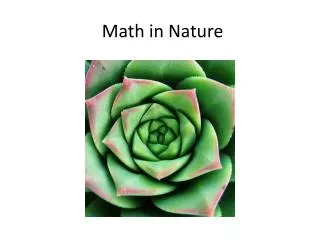
Purpose Using images from nature, your students will locate, identify, label, and create a presentation showing geometric objects.
Digital • Inexpensive • Immediate and unlimited images • Easily duplicated and stored • Digital cameras embedded in everything
Create Evaluate Analyze Apply Understand Remember Why ?
Inquiry-Based • Photographs “freeze” the image • Allow students to focus • Intent focus invites inquiry • Inquiry demands context • Context is the scaffolding of knowledge
To begin with inquiry based learning, we need to start with a base of what we know. • We know that we can identify shapes by their characteristics and properties. We know a shape with three sides is a triangle.
Are You Ready? Take at least 10 pictures in nature that represent geometric shapes. Following are some suggestions:
Ready? Take at least 10 pictures in nature You will need to return to your seat by: _________
Device Download • Use cable to connect device to computer • SD card into computer • Look for device as “additional drive” • Drag to your desktop
What is hidden in this picture? SQUARE
This Queen Anne Lace shows many? Triangles
This hawk will reveal…? rhombus
circle The pelican is eating a fish, but I see _______.
Parallel Lines What is the first thing you see? I know what I see?
Angles Acute Angles Right angle Obtuse Angle Hmmm? What shall I find amongst these leaves?
A line is a collection of points going on and on infinitely in both directions. It has no endpoints. What lies within this photograph?
Intersecting Lines What type of line has one end point in common?
Power Point Open power point program Download your photos Size photos to frame Then, begin to view one photo at a time to look for geometric figures If at first you do NOT see something…skip it and come back later!
Animation encourages… creating evaluating analyzing applying … using knowledge and understanding --think Bloom’s
Rubric Adapted from Science and Children magazine, A Picture is Worth a Thousand Words, January 2009
Benefits of Digital Photography in the Classroom • Promotes active engagement • Student-directed instruction • Instant feedback for students and teachers • Connects the classroom with real world • Promotes collaboration between students: provides a bank of photos to be used in the future
What do you see here? Everyone might see something differently.
Schedule • Introduction 10 minutes • Taking photos 15 minutes • Download photos 10 minutes • Examples of math in photos 10 minutes • Power Point work 30 minutes • Conclusion & door prizes 5 minutes