Quantum Memory for Entangled States of Light: Fidelity Exceeds Classical Benchmarks
This study explores the capabilities of quantum memory for storing entangled states of light, demonstrating that the fidelity achieved can surpass classical benchmarks. The research investigates the performance of various state classes, including coherent and squeezed states, and assesses memory operations like swap and squeezing. Special attention is given to the feedback mechanisms that optimize entanglement preservation and state transfer. The results highlight the potential applications in quantum metrology and information processing, paving the way for advancements in quantum technologies.

Quantum Memory for Entangled States of Light: Fidelity Exceeds Classical Benchmarks
E N D
Presentation Transcript
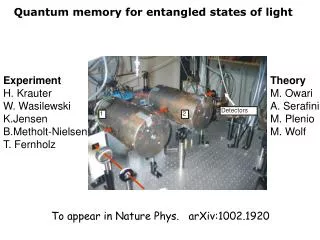
Detectors 1 2 Quantum memory for entangled states of light Experiment H. Krauter W. Wasilewski K.Jensen B.Metholt-Nielsen T. Fernholz Theory M. Owari A. Serafini M. Plenio M. Wolf To appear in Nature Phys. arXiv:1002.1920
Fidelity exceeds the classical benchmark memory can preserve entanglement Classical benchmark fidelity for state transfer for different classes of states: Coherent states (2005) N-dimentional Qubits (1982-2003) NEW! Displaced squeezed states (2008)
ξ-1 Best classical fidelity vs degree of squeezing for arbitrary displaced states ξ-1 – squeezed variance ξ-1 Squeezed states – classical benchmark fidelity: M.Owari et al New J. Phys. 2008
Two-mode squeezed = EPR entangled mode Einstein-Podolsky-Rosen (EPR) entanglement 0 7.6 3.8 6 dB SHG OPO
Storing ± Ω modes in superpositions of atomic Zeeman coherences ~ 1000 MHz MF = 5,4,3 MF = -3 MF = 4 - 320 kHz 320 kHz MF = -4 MF = 3
We don’t have infinite time (decoherence!). Measure transmitted light. Stop at and apply feedback conditioned on measurement result Time → ∞ Input-output relations atoms light Feedback magnetic coils Cesium atoms
After the feedback with optimal gain the memory operators become: Swap, squeezing and feedback in one protocol
CV entangled states stored with F > Fclassical 1 msec storage
ω12 • Frequency of atomic • transition as • standard of time Entanglement assisted atom clock Appel et al, PNAS – Proceedings of the National Academy of Science(2009) 106:10960-10965
Jz~X Jy~P Uncorrelated atoms: Projection noise Two level atom of a clock as a quasi-spin F=4 mF =0 ω12 = 9,192,631,770 Hz Cs clock levels: hyperfine ground states F=3 mF =0 Jx Measurable atomic operator
π/2 pulse π/2 pulse Ramsey fringes Ramsey method – a way to determine ω12 N2 ω12 N1
< Spin squeezed state Coherent spin state: PROJECTION NOISE Jz 0 Spin squeezed state of atomic ensemble δJ2z = ½N Jx Measurement of the population difference Nindependent atoms
Z Entangled atoms Entangled state cannot be written as a product of individual atom states Metrologically relevant spin squeezing = entanglement Angular uncertainty of the spin defines metrological significance Wineland et al 1992 Uncorrelated atoms (coherent spin state)
An ideal QND measurement • Conserves one quantum variable (operator P) • 2. Channels the backaction of the measurement • into the conjugate variable X • 3. Yields information about the P ω12 Our goal – measure the population difference in a QND way to generate a spin squeezed state Proposal by Kuzmich, Bigelow, Mandel in 1999. Quantum Nondemolition Measurement (QND) and Spin Squeezing A measurement changes the measured state standard QM textbook
QND of atomic population difference Atomic signal CESIUM LEVEL SCHEME 6P3/2 F=5 251 MHz F=4 201 MHz F=3 152 MHz F=2 In canonical variables: 6P1/2 F=4 1.17 GHz 852nm F=3 F=4 6S1/2 9.192 GHz F=3 Ideally no spontaneous emission nondemolition measurement of population difference Balanced photocurrent: Probe shot noise
Interferometry on a pencil-shaped atomic sample (dipole trapped Cs atoms T= 100 microK, 200.000 atoms)
QND measurement of atomic population difference Atomic signal Probe shot noise Atoms Interferometer measured phase shift around balanced position:
CESIUM LEVEL SCHEME 6P3/2 Maximal spin squeezing scales as 1/ d F=5 251 MHz F=4 201 MHz F=3 152 MHz F=2 6P1/2 F=4 1.17 GHz 852nm F=3 F=4 6S1/2 Maximum spin squeezing scales as 1/d 9.192 GHz F=3 Monochromatic versus bichromatic QND measurement D. Oblak, J. Appel, M. Saffman, EP PRA 2009
Juergen Appel Patrick Windpassinger Ulrich Hoff Niels Kjaergaard Daniel Oblak
Outcome: Best guess for second measurement First probe pulse: STEPS 2 and 3: generation and verification of spin squeezed state via QND measurement
Experimental parameters Up to 2*105 atoms probed 80 microns 55 microns Resonant optical depth up to 30 Optimal decoherence parameter η=0.2 Optimal photon number per QND 2*107 Expected projection noise reduction about 6 dB State lifetime ~ 0.2 msec
Two probe pulses Visibility reduction is (1-η) Determination of QND-induced decoherence η
Spin squeezing and entanglement Shot noise of QND probe J. Appel, P. Windpassinger, D. Oblak, U. Hoff, N. Kjærgaard, and E.S. Polzik. PNAS – Proceedings of the National Academy of Science(2009)106:10960-10965
Our result Multiparticle entanglement of an atom clock Multiparticle entanglement of a spin squeezed state 1 2 3 4 5 10 20 Sørensen, Mølmer, PRL 2001 Sanders et al
Can entanglement be created by dissipation? Collaboration with I. Cirac and C. Muschik
Nonlocal Lindblad equation for dissipation ~ 1000 MHz MF = 5,4,3 MF = 4 MF = -4 320 kHz MF = -3 MF = 3 Standard form of Lindblad equation for dissipation
Collective decoherence operators drive two ensembles into steady state EPR entangled (2-mode squeezed) state Driving field
Fast collective decoherence Slow single atom decoherence Time, msec theory data data
Conclusions Quantum state engineering and measurement allows for unprecedented precision of sensing Sub-femtotesla magnetometry with 1012 entangled atoms Entanglement assisted cold atom clock Entanglement assisted metrology and sensing is a part of Quantum Information Science