Why AVRs fail to protect Power-sensitive Equipment!
Why AVRs fail to protect Power-sensitive Equipment!. M. Navid Akram Ansari Managing Director Systek (Pvt.) Ltd. February 2019. FLOW. Writing on the Wall! Background Reasons Solution Features Conclusion Recommendation Outlook. Writing on the Wall!.

Why AVRs fail to protect Power-sensitive Equipment!
E N D
Presentation Transcript
Why AVRs fail to protectPower-sensitive Equipment! M. Navid Akram Ansari Managing Director Systek (Pvt.) Ltd. February 2019
FLOW • Writing on the Wall! • Background • Reasons • Solution • Features • Conclusion • Recommendation • Outlook
Writing on the Wall! ‘All ICT equipment shall fail sooner than later, unless ...’ (Anonymous) Not because of Murphy’s Law: ‘Anything that can go wrong will go wrong’
Writing on the Wall! Because: Wrong equipment being used for wrong application! AVRs JUST CANNOT PROTECT POWER-SENSITIVE EQUIPMENT Period!
BackgroundWhy? • Most of the ICT equipment employ SPS (Switch-mode Power Supply) • The ICT equipment mostly remain ON causing SPS components to age quickly • Thus they become more prone to fault on brown-out conditions • The capacitor of input filter, diode of the rectifier or the switching device may fail
BackgroundICT Equipment • Computers • Gateways • Routers • Switches • Hubs • Bridges • Adapters • VOIP Switches Brown-out Conditions • Sags • Surges • Spikes • Noise • Over-voltage • Under-voltage • EMI • RFI
BackgroundNature of ICT Equipment • Commonly narrow input voltage range • Prone to effects of brown-out conditions • Faulty SPS may pass RFI, spike or ripple to circuit • Power-sensitivity increases with increase in clock-speed • Require high-level of Power Quality & Reliability - PQR
BackgroundEnsuring PQR • Mains voltage stabilization • Electrical noise suppression • Harmonic filtrations • Electrical load isolation • Lightning protection • Mitigation of other brownout condition
ReasonsICT Equipment get damaged because • Following are deployed to protect them: • Conventional Automatic Voltage Regulators (AVR) • Line Conditioners incorporating such AVR • These AVRs are based on one of the following: • Relay • Servo-motor • Both these types of AVRs are ineffective in protecting ICT equipment due to their inherent shortcomings
ReasonsDrawbacks of Relay-based AVR • Sparking due to make and break of contacts • Early failure on frequent voltage fluctuations • Coarse voltage regulation due to finite tappings • Slower response on higher power ratings • Inability to mitigate brown-out conditions
ReasonsDrawbacks of Servo-based AVR • Slow response to changes in input voltage • Pass on sudden sags or surges to load • Gradual slowing of response over time • Early failure in dusty environment • Extreme output voltage upon resumption of mains power • Inability to mitigate brown-out conditions
Solution Solid-state Power-line Conditioner • Incorporating: • Solid-state Electronic AVR • Galvanic Isolation • Additional Protection • Most important is the SOLID-STATE AVR
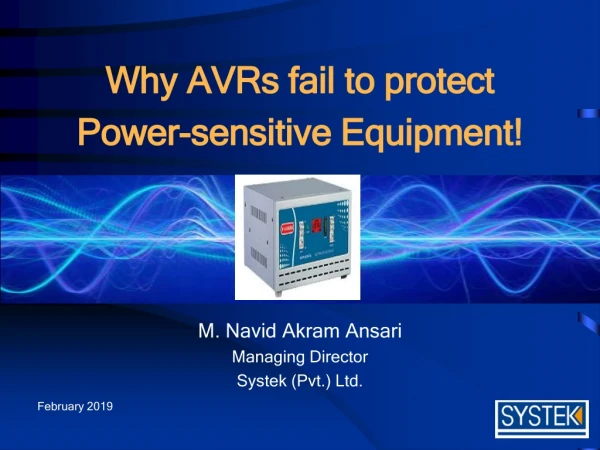
SolutionIndigenous Solution • PWM SOLID-STATE • POWER-LINE CONDITIONER • 40 kVA 3-f OUTDOOR UNIT • 40 kVA 3-f INDOOR UNIT • 10 kVA 1-f INDOOR UNIT
SolutionTechnology • Innovative Series-PWM Topology • Switch-mode Technology • High-frequency PWM Technology • Intelligent high-frequency chopping of Series Transformer • Employs IGBT modules
SolutionPrinciple • Series regulation transformer is used to control the output voltage • The output voltage is controlled through the secondary by stepping up or down the input voltage at the primary • The primary voltage is controlled by solid-state PWM switching of input voltage
SolutionSalient Features • Extremely fast response to changes in input voltage • Effective mitigation of brown-out conditions • Averse to dust due to solid-state parts • Provides Galvanic Isolation from mains • Very high efficiency • High power-to-size ratio
Conclusion • Conventional AVRs (Stabilizers) cannot protect the power-sensitive ICT equipment • Line Conditioners incorporating such relay or servo-based AVR cannot protect ICT equipment either • Such Line Conditioners are NOT the Power-line Conditioners that are suitable for ICT equipment • The only solution are the SOLID-STATE Power-line Conditioners based on Solid-state AVRs
Recommendation • Deploy ONLY SOLID-STATE Power-line Conditioners to effective protect power-sensitive ICT equipment • Deploy SOLID-STATE Power-line Conditioners with wide input voltage range at sites with poor power conditions • Deploy SOLID-STATE Power-line Conditioners with Isolation Transformers at sites with poor earthing
OutlookFuturistic Features • Event logging • Input power analysis • 3-f output even with 1 or 2-f outage • Internet and GPRS connectivity • Remote parameters monitoring • Remote operation control • AI for optimum performance
PLEASE REMEMBER! • All power-sensitive ICT equipment are • BOUND TO FAIL SOONER THAN LATER! • UNLESS: • Protected by SOLID-STATE • POWER-LINE CONDITIONER! • THANK YOU!