Download
1 / 26
260 likes | 368 Vues
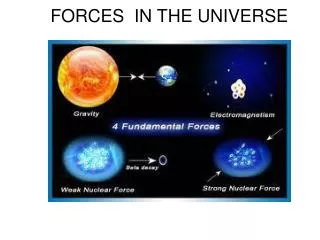
Forces are essential interactions that can start or stop movement, change an object's direction, or alter its speed. The universe is governed by four fundamental forces: Strong Nuclear Force, Weak Nuclear Force, Electromagnetic Force, and Gravity. Gravity, the weakest yet longest-range force, shapes our Solar System and affects everything from planetary orbits to tides. It plays a crucial role in various phenomena, including the motion of celestial bodies and the health of astronauts in space, highlighting the profound impact of gravitational interactions in our lives.

E N D
A force is a push or a pull What is a force? Forces can: Start or Stop objects moving Change direction or shape of an object Increase or decrease the speed of an object
Four Fundamental Forces 1. 2. 3. 4.
1. Strong Nuclear Force • An interaction between particles that hold the atomic nuclei together. It is mostly attractive but can be repulsive in some situations. • It is the strongest force • Short range (over 10-13 centimeters)
2. Weak Nuclear Force • An interaction between particles responsible for radioactive decay. • It is the 2nd weakest force • Short Range
3. Electromagnetic Force An interaction between particles that causes electric and magnetic effects. It can be attractive or repulsive. Acts only between pieces of matter carrying electrical charge. Responsible for the emission and absorption of photons (Electromagnetic Radiation). The phenomena of electricity and magnetism are consequences of this force.
4. Gravity • An attractive interaction between pieces of matter resulting from their mass and their distance. • Weakest force but long range (can stretch into infinite amount of space) • We would not exist without it
What do you already know about gravity? • Write down any knowledge you have on gravity.
Gravity is responsible for: Forming and maintaining (orbits)our Solar System
Interactionsbetween objects • The Sun has a vast effect on the motion of planets in our solar system. Even though planets are smaller than the Sun the planets still exert a gravitational pull on the Sun. • We can detect new planets in other solar systems due to wobbles in orbits of identified planets.
Earth’s Convection Currents Convection currents move matter toward core due to gravity and decreasing density Plate tectonics or movement of Earth’s plates is due to convection currents.
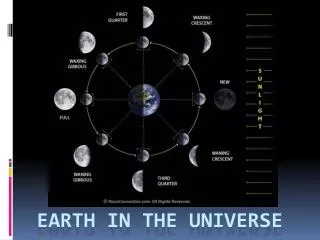
Earth’s Tides Tides are caused by the sun and moons gravitational pull, When the sun and moon are aligned, there are exceptionally strong gravitational forces, causing very high and very low tides which are called spring tides, though they have nothing to do with the season. When the sun and moon are not aligned, the gravitational forces cancel each other out, and the tides are not as dramatically high and low. These are called neap tides
Interactions in the Human Body As we age gravity affects the human body What problems do the astronauts have on their body while in space and far from Earth’s gravity ? • Muscle loss/decay • Bones become brittle • Blood centers near heart • Radiation exposure
Who was responsible for discovering the relationship between gravity and orbital paths?
Sir Issac Newton • Apple • Motion Laws • Inertia
The greater your mass the stronger… The closer your distance the stronger… Newton’s Law Recap
http://mediatheek.thinkquest.nl/~ll125/images/convect.jpgl http://hyperphysics.phy-astr.gsu.edu/hbase/forces/funfor.html#c3 http://library.thinkquest.org/C003763/images/adapt/spaceman.jpg http://quest.nasa.gov/space/teachers/rockets/images/satellite_orbit.gif http://www.astrosurf.com/cidadao/moon_99_02_23_south.jpg http://z.about.com/d/space/1/0/Y/Q/sun_tour.jpg http://ifpower.apogee.net/kids/graphics/lnh2.jpg http://library.thinkquest.org/27585/frameset_intro.htm http://library.thinkquest.org/27585/frameset_intro.htm Bibliography