IMMUNE SYSTEM
This chapter delves into the components of innate and adaptive immunity, exploring how the body defends itself from pathogens. It discusses innate defenses, including surface and cellular barriers such as skin, mucous membranes, and immune cells like phagocytes. The chemical defenses such as lysozymes and interferons are highlighted. Additionally, the chapter covers adaptive immunity, focusing on the roles of B and T lymphocytes, antigen recognition, antibody-mediated immunity, and T-cell activation. The concepts of immune homeostasis, transplant rejection, and autoimmune diseases are also discussed.

IMMUNE SYSTEM
E N D
Presentation Transcript
IMMUNE SYSTEM Chapter 21
Innate Defenses • Surface Barriers • Skin • Mucous membranes
Innate Defenses • Chemical Barriers • Mucus • Lysozymes • Saliva • Lacrimal fluid • High acidity • Gastric juices • Urine • Vaginal secretions • Sebum
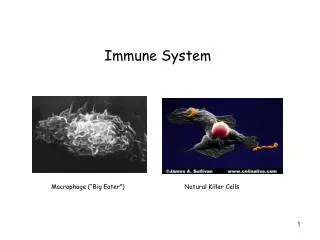
Innate Defenses • Cellular Defenses • Phagocytic cells • Macrophages or Monocytes • Free (alveolar) • Fixed (Kupffer) • Neutrophils • Dendritic cells
Phagocytic Mobilization • Alarm call • Vasodilation • Increased permeability • Leukocytosis • Margination • Diapedesis • Chemotaxis
Phagocytic Mechanism • Adherence • Ingestion • Phagosome • Digestion • Lysosome • Phagolysosome • Resolution
Innate Defenses • Cellular Defenses • Phagocytes • Inflammatory Cells • Mast Cells • Basophils • Eosinophils? • Natural Killer Cells
Anti-microbial Agents • Interferons
Anti-microbial Agents • Interferons • Complement • Pyrogens
Adaptive Immunity • Specific • Systemic • Memory
Adaptive Defenses • Antigens = “self” versus “non-self” • Major Histocompatibility Complex (MHC) • MHC I • MHC II
Antibody-Mediated Immunity • Also known as “humoral immunity” • Involves B lymphocytes • DIRECTLY recognizes antigen • B lymphocytes undergo clonal expansion
Cell-Mediated Immunity • Involves T lymphocytes • Cannot recognize antigen directly • Antigen must be presented by APC • T lymphocytes are more diverse: • Helper T cells • Cytotoxic T cells • Suppressor T cells • Memory T cells
Homeostatic Imbalances • Organ transplant and tissue rejection • Autograft • Isograft • Allograft • Xenograft • Immunodeficiency • Severe combined immunodeficiency syndrome (SCID) • Acquired immune deficiency syndrome (AIDS) • Human immunodeficiency virus (HIV)
Homeostatic Imbalances • Autoimmune diseases • Multiple sclerosis • Grave’s disease • Type I diabetes • Systemic lupus • Myasthenia gravis • Glomerulonephritis • Rheumatoid arthritis
Homeostatic Imbalances • Hypersensitivities • Immediate (Type I) • Subacute • Cytotoxic (Types II) • Immune-complex (Type III) • Delayed (Type IV)