Download
1 / 12
120 likes | 212 Vues
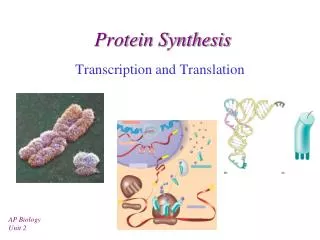
Explore the fascinating world of DNA and translation, where genes create proteins essential for cell and tissue formation. Learn about transcription and translation processes, mRNA codons, and the genetic code, unlocking the secrets of protein synthesis.

E N D
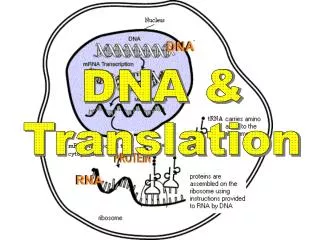
DNA & Translation
Gene: section of DNA that creates a specific protein Approx 25,000 human genes Proteins are used to build cells and tissue Protein synthesis involves two processes: 1) Transcription 2) Translation DNA and Translation
Transcription Review • Transcription takes place in the nucleus • 1) DNA double helix is broken apart • 2) mRNA nucleotides match up • 3) Finished mRNA detaches, and moves to a ribosome
Codon: Combination of 3 mRNA nucleotides Each mRNA codon matches with 1 of 20 amino acids Codon AAA = Lysine Codon GUU = Valine Codon AUG = Methionine (Start) Codons UAA or UAG or UGA = Stop The Genetic Code
Translation Overview • Defined: Process of making proteins • Step 1: mRNA enters ribosome • Step 2: Ribosome reads one mRNA codon at a time • Step 3: tRNA delivers amino acids until a protein is created
Translation begins when the mRNA codon “AUG” is reached Each mRNA codon matches with a specific amino acid AUG = methionine GCU = alanine tRNA carries over the proper amino acid tRNA anticodon matches with the mRNA codon One by one, amino acids are linked together Translation ends when a “stop” codon is reached End result: Polypeptide (protein) Translation Details
Practice Problem Threonine T G A A C U U G A
Practice Problem Lysine T T C A A G U U C
Interactive Protein Synthesis
Quick Review • Every DNA gene codes for a specific protein • Codon/anticodon match guarantees proper amino acid • Many amino acids link to make one protein video clip Fast forward 50 seconds