Implementing Winlink 2000 in South Texas: A Case Study from GAREC-07
This presentation covers the implementation of the Winlink 2000 system for amateur radio emergency communications in South Texas. Tom Whiteside, the District Emergency Coordinator for Digital Networks in South Texas A.R.E.S., provides an overview of Winlink 2000, including its deployment in various counties, and discusses its significance for emergency communications. Highlights include a high-level overview of the system, case studies, and the hierarchical structure of the network, demonstrating how Winlink can effectively support public safety and emergency response.

Implementing Winlink 2000 in South Texas: A Case Study from GAREC-07
E N D
Presentation Transcript
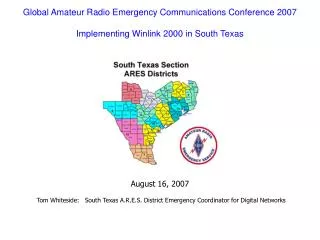
Global Amateur Radio Emergency Communications Conference 2007 Implementing Winlink 2000 in South Texas August 16, 2007 Tom Whiteside: South Texas A.R.E.S. District Emergency Coordinator for Digital Networks
GAREC-07 Implementing Winlink 2000 in South Texas Agenda • I.Brief Winlink Overview • II. Winlink 2000 County deployment Case Study • III. Winlink 2000 South Texas A.R.E.S deployment • IV. Discussion
GAREC-07 Implementing Winlink 2000 in South Texas Winlink 2000 User Position Reports
GAREC-07 Implementing Winlink 2000 in South Texas Winlink 2000 Overview • Winlink 2000 at a high level: • Winlink 2000 is a system for sending e-mail or bulletins over amateur radio • VHF/UHF Packet D-Star 802.11 connection for short range • HF PACTOR I, PACTOR II, PACTOR III for longer range • Winlink 2000 hierarchy: • Top Level: Redundant Common Message Servers (CMS) • 2nd Level: Participating Mail Box Office (PMBO) Mid level servers • 3rd Level: Telpac Internet gateway • 4th Level: Client applications: Paclink Airmail Outpost Telnet
GAREC-07 Implementing Winlink 2000 in South Texas Winlink 2000 Overview • Winlink 2000 at a high level: • Winlink 2000 is a system for sending e-mail or bulletinsover amateur radio • VHF/UHF Packet D-Star 802.11connection for short range • HF PACTOR I, PACTOR II, PACTOR III for longer range • Winlink 2000 hierarchy: • Top Level: Redundant Common Message Servers (CMS) • 2nd Level: Participating Mail Box Office (PMBO) Mid level servers • 3rd Level: Telpac Internet gateway • 4th Level: Client applications: Paclink Airmail Outpost Telnet
GAREC-07 Implementing Winlink 2000 in South Texas Winlink 2000 Overview • Winlink 2000 at a high level: • Winlink 2000 is a system for sending e-mail or bulletinsover amateur radio • VHF/UHF Packet D-Star 802.11connection for short range • HF PACTOR I, PACTOR II, PACTOR III for longer range • Winlink 2000 hierarchy: • Top Level: Redundant Common Message Servers (CMS) • 2nd Level: Participating Mail Box Office (PMBO) Mid level servers • 3rd Level: Telpac Internet gateway • 4th Level: Client applications: Paclink Airmail Outpost Telnet
GAREC-07 Implementing Winlink 2000 in South Texas Winlink 2000 Overview • Winlink 2000 at a high level: • Winlink 2000 is a system for sending e-mail over amateur radio • VHF/UHF Packet D-Star 802.11connection for short range • HF PACTOR I, PACTOR II, PACTOR III for longer range • Winlink 2000 hierarchy: • Top Level: Redundant Common Message Servers (CMS) • 2nd Level: Participating Mail Box Office (PMBO) Mid level servers • 3rd Level: Telpac Internet gateway • 4th Level: Client applications: Paclink Airmail Outpost Telnet
GAREC-07 Implementing Winlink 2000 in South Texas Winlink 2000 PMBOs World-wide 83 Public PMBOs
GAREC-07 Implementing Winlink 2000 in South Texas Winlink 2000 PMBOs World-wide 83 Public PMBOs 29 EMCOMM PMBOs
GAREC-07 Implementing Winlink 2000 in South Texas Winlink 2000 PMBOs World-wide 83 Public PMBOs 29 EMCOMM PMBOs 32 MARS PMBOs 1 UK Cadet PMBO
GAREC-07 Implementing Winlink 2000 in South Texas Winlink 2000 Overview • Winlink 2000 at a high level: • Winlink 2000 is a system for sending e-mail over amateur radio • VHF/UHF Packet D-Star 802.11connection for short range • HF PACTOR I, PACTOR II, PACTOR III for longer range • Winlink 2000 hierarchy: • Top Level: Redundant Common Message Servers (CMS) • 2nd Level: Participating Mail Box Office (PMBO) Mid level servers • 3rd Level: Telpac Internet packet gateway • 4th Level: Client applications: Paclink Airmail Outpost Telnet
GAREC-07 Implementing Winlink 2000 in South Texas World Wide Telpacs 346 Active shown
GAREC-07 Implementing Winlink 2000 in South Texas Winlink 2000 Overview • Winlink 2000 at a high level: • Winlink 2000 is a system for sending e-mail over amateur radio • VHF/UHF Packet D-Star 802.11connection for short range • HF PACTOR I, PACTOR II, PACTOR III for longer range • Winlink 2000 hierarchy: • Top Level: Redundant Common Message Servers (CMS) • 2nd Level: Participating Mail Box Office (PMBO) Mid level servers • 3rd Level: Telpac Internet packet gateway • 4th Level: Client applications: Paclink Airmail Outpost Telnet
GAREC-07 Implementing Winlink 2000 in South Texas II. Winlink 2000 County deployment Case Study Williamson County South Texas A.R.E.S. Section
GAREC-07 Implementing Winlink 2000 in South Texas South Texas A.R.E.S. Section
GAREC-07 Implementing Winlink 2000 in South Texas South Texas A.R.E.S. Section South Texas Statistics: 97 Counties 96,000 Square Miles 525 Miles East to West 450 Miles North to South 450 Miles of border with Mexico 600 Miles of coastline
GAREC-07 Implementing Winlink 2000 in South Texas South Texas A.R.E.S. Section Population: 11 million * * * *
GAREC-07 Implementing Winlink 2000 in South Texas South Texas A.R.E.S. Section Threats: Drought Flooding Extreme Heat Ice Storms Tornadoes Hurricanes Severe Thunderstorms Lightning Hazmat Petrochemical plants / transportation Radiological – Nuclear plants Terrorism
GAREC-07 Implementing Winlink 2000 in South Texas Williamson County Texas A.R.E.S Path to Winlink *
GAREC-07 Implementing Winlink 2000 in South Texas • Phase 0 pre-Winlink • October 2003 Weapons of Mass Destruction drill • January 2004 Year end goal: • Packet Messaging system • Central Node • 8 Portable Packet Stations – “Packet Cavalry” • 2005 goal to tie-in with ARRL HF National Traffic System (NTS) • June 2004 • Architected template driven system • June 2004 ARRL Field Day passed messages with system • Antenna/feedline investment decision for central high node • July 2004 • ARRL endorses Winlink 2000 system • Our A.R.E.S Section Emergency Coordinator asks County Emergency Coordinators to consider Winlink 2000 • WC-ARES decision to “transfer the flag” to Winlink 2000
GAREC-07 Implementing Winlink 2000 in South Texas • Phase 0 pre-Winlink • October 2003 Weapons of Mass Destruction drill • January 2004 Year end goal: • Packet Messaging system • Central Node • 8 Portable Packet Stations – “Packet Cavalry” • 2005 goal to tie-in with ARRL HF National Traffic System (NTS) • June 2004 • Architected template driven system • June 2004 ARRL Field Day passed messages with system • Antenna/feedline investment decision for central high node • July 2004 • ARRL endorses Winlink 2000 system • Our A.R.E.S Section Emergency Coordinator asks County Emergency Coordinators to consider Winlink 2000 • WC-ARES decision to “transfer the flag” to Winlink 2000
GAREC-07 Implementing Winlink 2000 in South Texas • Phase 0 pre-Winlink • October 2003 Weapons of Mass Destruction drill • January 2004 Year end goal: • Packet Messaging system • Central Node • 8 Portable Packet Stations – “Packet Cavalry” • 2005 goal to tie-in with ARRL HF National Traffic System (NTS) • June 2004 • Architected template driven system • June 2004 ARRL Field Day passed messages with system • Antenna / feed line investment decision for central high node • July 2004 • ARRL endorses Winlink 2000 system • Our A.R.E.S Section Emergency Coordinator asks County Emergency Coordinators to consider Winlink 2000 • WC-ARES decision to “transfer the flag” to Winlink 2000
GAREC-07 Implementing Winlink 2000 in South Texas • Phase 0 pre-Winlink • October 2003 Weapons of Mass Destruction drill • January 2004 Year end goal: • Packet Messaging system • Central Node • 8 Portable Packet Stations – “Packet Cavalry” • 2005 goal to tie-in with ARRL HF National Traffic System (NTS) • June 2004 • Architected template driven system • June 2004 ARRL Field Day passed messages with system • Antenna / feed line investment decision for central high node • July 2004 • ARRL endorses Winlink 2000 system • Our A.R.E.S Section Emergency Coordinator asks County Emergency Coordinators to consider Winlink 2000 • WC-ARES decision to “transfer the flag” to Winlink 2000
GAREC-07 Implementing Winlink 2000 in South Texas • Phase 1 Winlink first beginnings • Strategy: • Create a web of Telpac stations with diverse Internet suppliers • Create a portable response team with goal of 8 by YE growing to 16 • Sell the system and drive for EOC permanent installs • Invest in an SCS HF PACTOR III TNC • Investigate establishing an EMCOMM PMBO • August 2004: First 2 Telpac nodes and portable stations • October 2004: Simulated Emergency Test utilizing Winlink 2000 • First ARES SET to use Winlink 2000 since ARRL board announcement
GAREC-07 Implementing Winlink 2000 in South Texas • Phase 1 Winlink first beginnings • Strategy: • Create a web of Telpac stations with diverse Internet suppliers • Create a portable response team with goal of 8 by YE growing to 16 • Sell the system and drive for EOC permanent installs • Invest in an SCS HF PACTOR III TNC • Investigate establishing an EMCOMM PMBO • August 2004: First 2 Telpac nodes and portable stations • October 2004: Simulated Emergency Test utilizing Winlink 2000 • First ARES SET to use Winlink 2000 since ARRL board announcement
GAREC-07 Implementing Winlink 2000 in South Texas September 2004 Two “Instant” Telpac Nodes Telpac Node Digipeater
GAREC-07 Implementing Winlink 2000 in South Texas • Phase 1 Winlink first beginnings • Strategy: • Create a web of Telpac stations with diverse Internet suppliers • Create a portable response team with goal of 8 by YE growing to 16 • Sell the system and drive for EOC permanent installs • Invest in an SCS HF PACTOR III TNC • Investigate establishing an EMCOMM PMBO • August 2004: First Telpac nodes and portable stations • October 2004: Simulated Emergency Test (SET) using Winlink 2000 • First ARES SET to use Winlink 2000 since ARRL board announcement
GAREC-07 Implementing Winlink 2000 in South Texas • Phase 2 Expanding the plan • November 2004: VHF PMBO (3rd EMCOMM PMBO) • Extending the N5TW PMBO • March 2005: HF PACTOR added to PMBO • May 2005: Second VHF Telpac on PMBO • May 2005: Weekly Packet Cavalry nets begun • June 2005: 350 foot “high Telpac” on-line (Telpac #4) • July 2005: City of Cedar Park EOC Telpac on-line (Telpac #5) • August 2005: Georgetown Hospital Telpac on-line (Telpac #6) • August 2005: Hurricane Katrina • September 2005: City of Round Rock EOC Telpac on-line (Telpac #7) • September 2005: Hurricane Rita • October 2005: Full out Simulated Emergency Test • December 2005: • 32 Portable VHF Packet stations • 6 HF Portable PACTOR with 3 being PACTOR III • January 2006: Round Rock Medical Center on-line (Telpac #8) • April 2006: 2nd HF Radio/SCS TNC at N5TW PMBO
GAREC-07 Implementing Winlink 2000 in South Texas • Phase 2 Expanding the plan • November 2004: VHF PMBO (3rd EMCOMM PMBO) • Extending the N5TW PMBO • March 2005: HF PACTOR added to PMBO • May 2005: Second VHF Telpac on PMBO • May 2005: Weekly Packet Cavalry nets begun • June 2005: 350 foot “high Telpac” on-line (Telpac #4) • July 2005: City of Cedar Park EOC Telpac on-line (Telpac #5) • August 2005: Georgetown Hospital Telpac on-line (Telpac #6) • August 2005: Hurricane Katrina • September 2005: City of Round Rock EOC Telpac on-line (Telpac #7) • September 2005: Hurricane Rita • October 2005: Full out Simulated Emergency Test • December 2005: • 32 Portable VHF Packet stations • 6 HF Portable PACTOR with 3 being PACTOR III • January 2006: Round Rock Medical Center on-line (Telpac #8) • April 2006: 2nd HF Radio/SCS TNC at N5TW PMBO
GAREC-07 Implementing Winlink 2000 in South Texas • Phase 2 Expanding the plan • November 2004: VHF PMBO (3rd EMCOMM PMBO) • Extending the N5TW PMBO • March 2005: HF PACTOR added to PMBO • May 2005: Second VHF Telpac on PMBO • May 2005: Weekly Packet Cavalry nets begun • June 2005: 350 foot “high Telpac” on-line (Telpac #4) • July 2005: City of Cedar Park EOC Telpac on-line (Telpac #5) • August 2005: Georgetown Hospital Telpac on-line (Telpac #6) • August 2005: Hurricane Katrina • September 2005: City of Round Rock EOC Telpac on-line (Telpac #7) • September 2005: Hurricane Rita • October 2005: Full out Simulated Emergency Test • December 2005: • 32 Portable VHF Packet stations • 6 HF Portable PACTOR with 3 being PACTOR III • January 2006: Round Rock Medical Center on-line (Telpac #8) • April 2006: 2nd HF Radio/SCS TNC at N5TW PMBO
GAREC-07 Implementing Winlink 2000 in South Texas • Phase 2 Expanding the plan • November 2004: VHF PMBO (3rd EMCOMM PMBO) • Extending the N5TW PMBO • March 2005: HF PACTOR added to PMBO • May 2005: Second VHF Telpac on PMBO • May 2005: Weekly Packet Cavalry nets begun • June 2005: 350 foot “high Telpac” on-line (Telpac #4) • July 2005: City of Cedar Park EOC Telpac on-line (Telpac #5) • August 2005: Georgetown Hospital Telpac on-line (Telpac #6) • August 2005: Hurricane Katrina • September 2005: City of Round Rock EOC Telpac on-line (Telpac #7) • September 2005: Hurricane Rita • October 2005: Full out Simulated Emergency Test • December 2005: • 32 Portable VHF Packet stations • 6 HF Portable PACTOR with 3 being PACTOR III • January 2006: Round Rock Medical Center on-line (Telpac #8) • April 2006: 2nd HF Radio/SCS TNC at N5TW PMBO
GAREC-07 Implementing Winlink 2000 in South Texas • Phase 2 Expanding the plan • November 2004: VHF PMBO (3rd EMCOMM PMBO) • Extending the N5TW PMBO • March 2005: HF PACTOR added to PMBO • May 2005: Second VHF Telpac on PMBO • May 2005: Weekly Packet Cavalry nets begun • June 2005: 350 foot “high Telpac” on-line (Telpac #4) • July 2005: City of Cedar Park EOC Telpac on-line (Telpac #5) • August 2005: Georgetown Hospital Telpac on-line (Telpac #6) • August 2005: Hurricane Katrina • September 2005: City of Round Rock EOC Telpac on-line (Telpac #7) • September 2005: Hurricane Rita • October 2005: Full out Simulated Emergency Test • December 2005: • 32 Portable VHF Packet stations • 6 HF Portable PACTOR with 3 being PACTOR III • January 2006: Round Rock Medical Center on-line (Telpac #8) • April 2006: 2nd HF Radio/SCS TNC at N5TW PMBO
GAREC-07 Implementing Winlink 2000 in South Texas • Phase 2 Expanding the plan • November 2004: VHF PMBO (3rd EMCOMM PMBO) • Extending the N5TW PMBO • March 2005: HF PACTOR added to PMBO • May 2005: Second VHF Telpac on PMBO • May 2005: Weekly Packet Cavalry nets begun • June 2005: 350 foot “high Telpac” on-line (Telpac #4) • July 2005: City of Cedar Park EOC Telpac on-line (Telpac #5) • August 2005: Georgetown Hospital Telpac on-line (Telpac #6) • August 2005: Hurricane Katrina • September 2005: City of Round Rock EOC Telpac on-line (Telpac #7) • September 2005: Hurricane Rita • October 2005: Full out Simulated Emergency Test • December 2005: • 32 Portable VHF Packet stations • 6 HF Portable PACTOR with 3 being PACTOR III • January 2006: Round Rock Medical Center on-line (Telpac #8) • April 2006: 2nd HF Radio/SCS TNC at N5TW PMBO
GAREC-07 Implementing Winlink 2000 in South Texas • Phase 2 Expanding the plan • November 2004: VHF PMBO (3rd EMCOMM PMBO) • Extending the N5TW PMBO • March 2005: HF PACTOR added to PMBO • May 2005: Second VHF Telpac on PMBO • May 2005: Weekly Packet Cavalry nets begun • June 2005: 350 foot “high Telpac” on-line (Telpac #4) • July 2005: City of Cedar Park EOC Telpac on-line (Telpac #5) • August 2005: Georgetown Hospital Telpac on-line (Telpac #6) • August 2005: Hurricane Katrina • September 2005: City of Round Rock EOC Telpac on-line (Telpac #7) • September 2005: Hurricane Rita • October 2005: Full out Simulated Emergency Test • December 2005: • 32 Portable VHF Packet stations • 6 HF Portable PACTOR with 3 being PACTOR III • January 2006: Round Rock Medical Center on-line (Telpac #8) • April 2006: 2nd HF Radio/SCS TNC at N5TW PMBO
GAREC-07 Implementing Winlink 2000 in South Texas • Phase 2 Expanding the plan • November 2004: VHF PMBO (3rd EMCOMM PMBO) • Extending the N5TW PMBO • March 2005: HF PACTOR added to PMBO • May 2005: Second VHF Telpac on PMBO • May 2005: Weekly Packet Cavalry nets begun • June 2005: 350 foot “high Telpac” on-line (Telpac #4) • July 2005: City of Cedar Park EOC Telpac on-line (Telpac #5) • August 2005: Georgetown Hospital Telpac on-line (Telpac #6) • August 2005: Hurricane Katrina • September 2005: City of Round Rock EOC Telpac on-line (Telpac #7) • September 2005: Hurricane Rita • October 2005: Full out Simulated Emergency Test • December 2005: • 32 Portable VHF Packet stations • 6 HF Portable PACTOR with 3 being PACTOR III • January 2006: Round Rock Medical Center on-line (Telpac #8) • April 2006: 2nd HF Radio/SCS TNC at N5TW PMBO
GAREC-07 Implementing Winlink 2000 in South Texas • Phase 2 Expanding the plan • November 2004: VHF PMBO (3rd EMCOMM PMBO) • Extending the N5TW PMBO • March 2005: HF PACTOR added to PMBO • May 2005: Second VHF Telpac on PMBO • May 2005: Weekly Packet Cavalry nets begun • June 2005: 350 foot “high Telpac” on-line (Telpac #4) • July 2005: City of Cedar Park EOC Telpac on-line (Telpac #5) • August 2005: Georgetown Hospital Telpac on-line (Telpac #6) • August 2005: Hurricane Katrina • September 2005: City of Round Rock EOC Telpac on-line (Telpac #7) • September 2005: Hurricane Rita • October 2005: Full out Simulated Emergency Test • December 2005: • 32 Portable VHF Packet stations • 6 HF Portable PACTOR with 3 being PACTOR III • January 2006: Round Rock Medical Center on-line (Telpac #8) • April 2006: 2nd HF Radio/SCS TNC at N5TW PMBO
GAREC-07 Implementing Winlink 2000 in South Texas • Phase 2 Expanding the plan • November 2004: VHF PMBO (3rd EMCOMM PMBO) • Extending the N5TW PMBO • March 2005: HF PACTOR added to PMBO • May 2005: Second VHF Telpac on PMBO • May 2005: Weekly Packet Cavalry nets begun • June 2005: 350 foot “high Telpac” on-line (Telpac #4) • July 2005: City of Cedar Park EOC Telpac on-line (Telpac #5) • August 2005: Georgetown Hospital Telpac on-line (Telpac #6) • August 2005: Hurricane Katrina • September 2005: City of Round Rock EOC Telpac on-line (Telpac #7) • September 2005: Hurricane Rita • October 2005: Full out Simulated Emergency Test • December 2005: • 32 Portable VHF Packet stations • 6 HF Portable PACTOR with 3 being PACTOR III • January 2006: Round Rock Medical Center on-line (Telpac #8) • April 2006: 2nd HF Radio/SCS TNC at N5TW PMBO
GAREC-07 Implementing Winlink 2000 in South Texas • Phase 2 Expanding the plan • November 2004: VHF PMBO (3rd EMCOMM PMBO) • Extending the N5TW PMBO • March 2005: HF PACTOR added to PMBO • May 2005: Second VHF Telpac on PMBO • May 2005: Weekly Packet Cavalry nets begun • June 2005: 350 foot “high Telpac” on-line (Telpac #4) • July 2005: City of Cedar Park EOC Telpac on-line (Telpac #5) • August 2005: Georgetown Hospital Telpac on-line (Telpac #6) • August 2005: Hurricane Katrina • September 2005: City of Round Rock EOC Telpac on-line (Telpac #7) • September 2005: Hurricane Rita • October 2005: Full out Simulated Emergency Test • December 2005: • 32 Portable VHF Packet stations • 6 HF Portable PACTOR with 3 being PACTOR III • January 2006: Round Rock Medical Center on-line (Telpac #8) • April 2006: 2nd HF Radio/SCS TNC at N5TW PMBO
GAREC-07 Implementing Winlink 2000 in South Texas • Phase 2 Expanding the plan • November 2004: VHF PMBO (3rd EMCOMM PMBO) • Extending the N5TW PMBO • March 2005: HF PACTOR added to PMBO • May 2005: Second VHF Telpac on PMBO • May 2005: Weekly Packet Cavalry nets begun • June 2005: 350 foot “high Telpac” on-line (Telpac #4) • July 2005: City of Cedar Park EOC Telpac on-line (Telpac #5) • August 2005: Georgetown Hospital Telpac on-line (Telpac #6) • August 2005: Hurricane Katrina • September 2005: City of Round Rock EOC Telpac on-line (Telpac #7) • September 2005: Hurricane Rita • October 2005: Full out Simulated Emergency Test • December 2005: • 32 Portable VHF Packet stations • 6 HF Portable PACTOR with 3 being PACTOR III • January 2006: Round Rock Medical Center on-line (Telpac #8) • April 2006: 2nd HF Radio/SCS TNC at N5TW PMBO
GAREC-07 Implementing Winlink 2000 in South Texas • Phase 2 Expanding the plan • November 2004: VHF PMBO (3rd EMCOMM PMBO) • Extending the N5TW PMBO • March 2005: HF PACTOR added to PMBO • May 2005: Second VHF Telpac on PMBO • May 2005: Weekly Packet Cavalry nets begun • June 2005: 350 foot “high Telpac” on-line (Telpac #4) • July 2005: City of Cedar Park EOC Telpac on-line (Telpac #5) • August 2005: Georgetown Hospital Telpac on-line (Telpac #6) • August 2005: Hurricane Katrina • September 2005: City of Round Rock EOC Telpac on-line (Telpac #7) • September 2005: Hurricane Rita • October 2005: Full out Simulated Emergency Test • December 2005: • 32 Portable VHF Packet stations • 6 HF Portable PACTOR with 3 being PACTOR III • January 2006: Round Rock Medical Center on-line (Telpac #8) • April 2006: 2nd HF Radio/SCS TNC at N5TW PMBO
GAREC-07 Implementing Winlink 2000 in South Texas April 2006 VHF Coverage Digipeater
GAREC-07 Implementing Winlink 2000 in South Texas N5TW PMBO N5TW-10 2-Bay center up 85 feet N5TW HF BW Multi-band dipole Feed point up 45 feet N5TW-12 Center up 120 feet
GAREC-07 Implementing Winlink 2000 in South Texas N5TW PMBO HF / N5TW-10 PS N5TW-12 PS TNC Stack N5TW HF N5TW-12 N5TW-10
GAREC-07 Implementing Winlink 2000 in South Texas N5TW PMBO – 2nd Radio
GAREC-07 Implementing Winlink 2000 in South Texas N5TW PMBO – Generator / Switchover panel
GAREC-07 Implementing Winlink 2000 in South Texas III. Winlink 2000 South Texas A.R.E.S deployment
GAREC-07 Implementing Winlink 2000 in South Texas III. Winlink 2000 South Texas A.R.E.S deployment Strategy: Maximize local Telpac Coverage with redundancy EMCOMM PMBOs with HF/Telpacs in areas > million people Winlink 2000 equipped served agencies HF in vulnerable and low population density areas Trained / equipped deployable teams with Winlink capability