Governance Structure of All Saints Centre for Mission and Ministry
All Saints is a charitable trust and a Church of England institution governed by its Memorandum and Articles, the Charity Commission, and general law. It serves as a center for training ministry leaders, operating with a governance board responsible for strategy-setting, staff employment, and funding. Key committees include Finance and General Purposes, Academic, and Risk and Audit, ensuring oversight of financial and academic standards. The Centre collaborates with several universities and dioceses, supporting ordination training and ensuring quality assurance in education.

Governance Structure of All Saints Centre for Mission and Ministry
E N D
Presentation Transcript
All Saints is … • A company limited by guaranteegoverned by its Memorandum and Articlesand company and general law • A charitable trustwith specific charitable aims and objectivesgoverned by the Charity Commission and charity law • A recognised Church of England TEIwith accountability to the House of Bishops via Ministry Division • A partnership between dioceses • People training for ministry
All Saints’ Board • In Attendance
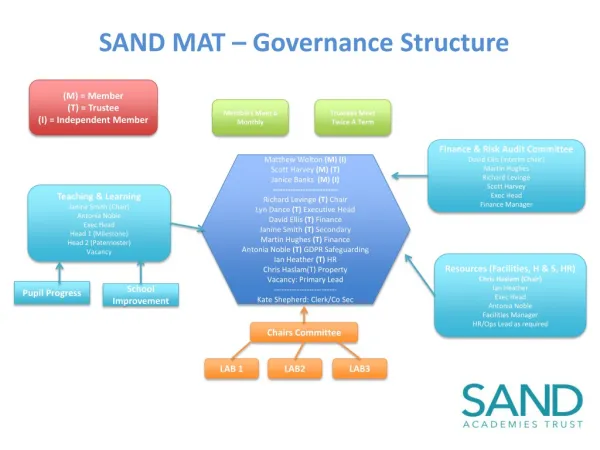
The Board … • has overall governance responsibility for All Saints • sets strategy, priorities and policies • employs staff • is responsible for funding the work • works within the law and its “Mem & Arts”
All Saints’ Committees • Academic
Committees • The Memorandum and Articles of Association established three committees • Finance and General Purposes Committee • Academic Committee • Risk and Audit Committee • … and allows for other committees and working groups as the Boardit sees fit
Committee Membership • Trustees • Ex Officio Staff • Elected staff and students • Other invitees/co-optees • Staff (and others) in attendance
Finance and General Purposes • Finance • Drawing-up the budget for the Board • Monitoring income and expenditure through quarterly management accounts • Staffing • Employment policies and procedures • All contractual matters • Remuneration, expenses, etc • General • All substantial contracts and agreements
Academic Committee • Deliberately “open” • Three universities with different academic structures • Currently a “Board of Studies” chaired by a Trustee • Under Common Awards, a “Management Committee” chaired by the Principal • Educational and Academic • Policies • Quality Assurance and Enhancement • Reviewing the course
Risk and Audit Committee • Recently established • To oversee the company’s annual financial external examination or full audit • To assess and review the risks to the company/charity and advise on policies and procedures to mitigate those risks
Strategic Partnerships All Saints Centre
Strategic Relationships • Recognition by Archbishops’ Council for training Ordinands • Agreements with Higher Education Partners • Liverpool Hope University • University of Chester • Durham University • Agreements with Dioceses
Church of England • Validates All Saints for ordination training, with basic standards for • ethos and curriculum • staffing and resources • governance and finance • Inspects institution to ensure quality • Pays standard fees for each ordinand
Universities • Validation / Revalidation • basic philosophy, alignment and course design • modules, assessment, qualifications of tutors, quality • Partnership Agreement • terms of relationship including financial costs • financial sustainability and resources for delivery • Programme Agreement • authorises All Saints to teach agreed programme of study for a University award • University regulations
Agreements with Dioceses • Main contact person • Joint appointment of Directors of Studies • Recommending and appointing tutors • Number and location of teaching centres • Payment for Reader-training • Arrangements for placements • Involvement in committees • Notice of withdrawal
Course Office Staff • Employed by All Saints Centre for Mission and Ministry • Academic staff – Principal and Vice-Principal • Admin Team – Company Secretary/ Administrator and two Admin Assistants
Module Leaders • Subject specialists appointed by Principal from among • employed academic staff (Principal and Vice-Principal) • Directors of Study who are “seconded” by their diocese to work mainly with All Saints as part of the Course Management Team • i.e. CMT members • Work with module teams deliver and assess modules, develop module and programme curriculum, teaching strategies and resources • Review modules and programme annually
Tutors • People with subject interest and teaching skills • Recommended by diocesan partners and based in dioceses • Interviewed and appointed by Principal • Agree to work within the aims of the Course • Supported through: • Induction session/s and Tutor Handbook • Module Leader and module team meetings • Staff Development Days • Peer observation scheme • Book grant of £100 • Payment of travel and preparation expenses
Tutors Five different “categories” of people who teach and assess as part of their role • Employed staff (Principal and Vice-Principal) • Seconded staff (CMT members) • Tutors recommended by their diocese who are employed or stipended and whose teaching is part of their work or ministry • Tutors recommended by a diocese who are not employed or fully stipended and whose teaching we pay for • “Guest” or “visting” tutors …
Directors of Studies • Appointed jointly by diocese and Principal and based in dioceses • Oversight of formational and academic development of students from their diocese • Agree student learning plans with Principal • Arrange student placements • First port of call for guidance and support
Course Management Team Specific course-wide portfolios or roles • Timetable, calendar and venue-planning • VLE Manager • Communication and Website Manager • Diversity, Inclusion and Gender Issues • Administrator • Quality and Student Progress
Staffing and Management Principal – John Applegate Tutorial • Vice-PrincipalVacant • Partner Staff – Module Leaders and Directors of Studies • Simon Chesters • Gary O’Neill • Alan Scantlebury • Liz Shercliff • Partner Staff – Part-time Tutors • About fifty women and men across six dioceses Administration Course AdministratorLiz Liddle Two Admin Assistants Placement Supervisors • Parish and Sector clergy • Other community leaders • Up to two hundred each year across six dioceses
Student Liaison Group • Purpose is to listen, pass-on and respond to student views in order to improve the student experience and quality of learning • Elected reps for Reader-candidates, licensed Readers, Ordinands … from each teaching centre and year group • Chaired by Vice-Principal, with Principal and Administrator plus other staff as necessary • Review module and end-of-year evaluations • Elect to Academic Committee and Board
All Saints’ “Committees” • Academic • CMT • SLG
Durham Management Committee • Having a Management Committee for Durham awards will be required by the contract between Durham University and All Saints. • This will change our structures as the Management Committee will be responsible for areas currently covered by CMT and the Academic Committee. • See the handout for functions, membership and terms of reference.
Durham Management Committee • The Head of the TEI (Principal - Chair). • The Programme Director(s) for the programme(s) offered under this agreement. • Other academic staff of the TEI involved in the delivery of the programme(s) offered under this agreement. • One student representative for each of the academic levels of study offered by the TEI under the agreement. • The University Liaison Officer(s) appointed by the University for the programme(s) for which the Committee is responsible.
Future Academic Structure • Currently, one programme with Principal as Programme Leader • 2015 sees transition from Chester/LHU programme to the new Durham Common Awards “suite” of programmes • Common Awards programmes may have different leaders, responsible to the Principal • Accreditation (or not) of Reader-training courses may require more complex arrangements within the region
Income – two main sources • The “Vote 1” Grant from the Archbishops’ Council for training ordinands • Depends on the number of ordinands • Potentially, the grant changes from year to year • Diocesan block payments for Reader-training • Stable for 2-3 years • Does not depend on the number of Reader-candidates or Readers • Effectively, dioceses pay to have Reader-training available • Minor income includes • Fees for Independent Students • Fees for Isle of Man Reader-candidates
Expenditure – three main items • Direct costs of training Ordinands • Direct costs of training Readers • General costs of running and developing a training organisation to meet dioceses’ and wider Church needs
Basic Figures • Vote 1 Grant ~£350,000 • Reader-training Grants ~£150,000 • Annual turnover ~£500,000 • Grant per ordinand ~£ 5,500 • Grant per diocese ~£ 36,000 • Ordinands in 2014/15 ~57 • Reader-candidates ~120 • Readers, post-licensing ~60