Understanding the Narrowband Fading Model: Signal Components and Their Correlation
80 likes | 194 Vues
This lecture reviews the characteristics of the narrowband fading model, focusing on in-phase and quadrature signal components under uniform scattering conditions. Key aspects include the effects of multipath arrival angles on the autocorrelation and cross-correlation of received signals. The lecture also discusses the power spectral density (PSD) and the statistical distributions (Rayleigh, Ricean, Nakagami) that describe signal envelope behaviors. Insights into how these phenomena impact the received signal's performance in real-world scenarios are analyzed.


Understanding the Narrowband Fading Model: Signal Components and Their Correlation
E N D
Presentation Transcript
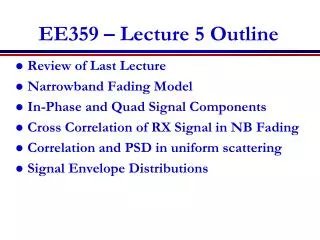
Review of Last Lecture Narrowband Fading Model In-Phase and Quad Signal Components Cross Correlation of RX Signal in NB Fading Correlation and PSD in uniform scattering Signal Envelope Distributions EE359 – Lecture 5 Outline
Review of Last Lecture • Model Parameters from Measurements • Random Multipath Model • Channel Impulse Response • Received signal characteristics • Many multipath components • Amplitudes change slowly • Phases change rapidly
Narrowband Model • Assume delay spread maxm,n|tn(t)-tm(t)|<<1/B • Then u(t)u(t-t). • Received signal given by • No signal distortion (spreading in time) • Multipath affects complex scale factor in brackets. • Characterize scale factor by setting u(t)=ejf0
In-Phase and Quadratureunder CLT Approximation • In phase and quadrature signal components: • For N(t) large, rI(t) and rQ(t) jointly Gaussian by CLT (sum of large # of random vars). • Received signal characterized by its mean, autocorrelation, and cross correlation. • If jn(t) uniform, the in-phase/quad components are mean zero, indep., and stationary.
Auto and Cross Correlation , fn~U[0,2p] • Recall that qn is the multipath arrival angle • Autocorrelation of inphase/quad signal is • Cross Correlation of inphase/quad signal is • Autocorrelation of received signal is
Uniform AOAs • Under uniform scattering, in phase and quad comps have no cross correlation and autocorrelation is • The PSD of received signal is Decorrelates over roughly half a wavelength Sr(f) Used to generate simulation values fc fc+fD fc-fD
Signal Envelope Distribution • CLT approx. leads to Rayleigh distribution (power is exponential) • When LOS component present, Ricean distribution is used • Measurements support Nakagami distribution in some environments • Similar to Ricean, but models “worse than Rayleigh” • Lends itself better to closed form BER expressions
Main Points • Narrowband model has in-phase and quad. comps that are zero-mean stationary Gaussian processes • Auto and cross correlation depends on AOAs of multipath • Uniform scattering makes autocorrelation of inphase and quad comps of RX signal follow Bessel function • Signal components decorrelate over half wavelength • The PSD has a bowel shape centered at carrier frequency • Fading distribution depends on environment • Rayleigh, Ricean, and Nakagami all common