Download
1 / 10
100 likes | 225 Vues
The World Water Council's framework aims to monitor and enhance global water actions leading to 2025. This report outlines key initiatives and offers recommendations for improving water governance, risk management, and financing. Although progress is being made, challenges such as partial data coverage and the enforcement of water-related legislation persist. The need for prioritizing water in planning and budgeting processes is emphasized to meet Millennium Development Goals. Increased awareness and stakeholder engagement are essential for sustainable water management.

E N D
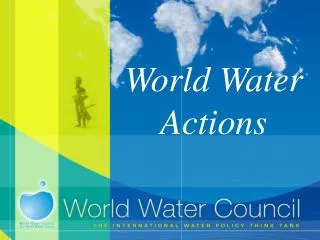
World Water Actions The Hague: Vision for 2025 Framework for Action Kyoto: Actions and Commitments World Water Council pledged in The Hague to monitor the progress made
World Water Actions • Method: collection of information on on-going initiatives from all stakeholders • Limitations: • Gradual progress ? • Partial coverage, but meaningful sample • Boundaries of the water sector? • No quality check
www.worldwatercouncil.org Actions Database • As by today, 2315 Actions • Water Action Contest submissions still to be entered (around 870 projects)
Outline of the report • Create an enabling environment : management and institutions, risk management, finances • “WEHAB” issues • Water supply and sanitation • Energy • Health • Agriculture • Biodiversity • 3. Recommendations
Outcomes • The “Actions” concept is an expedient for assessing progress in absence of indicators. Monitoring of progress still an issue. • Legislation and institutions: lot of efforts are on-going. Main hurdle: enforcing the legislations. Some changes go beyond the water sector (decentralization; participation). • Institutional progress prioritized – but practical management issues not to be forgotten
Outcomes • Financing is a major issue. Camdessus Panel recommendations awaited. • Water is now on the international agenda (Bonn, Johannesburg); Millennium Development Goals influence strategies of international players. • But water is not in the top priorities of decision-makers (governments, local authorities) – and not in the priorities of people?
Recommendations • Real priority should be given to water, and translated in budgetary allocations and planning processes by governments and local authorities. Without this, MDGs will not be achieved. • Awareness raising is a never-ending necessity; there is a need for arguments to help convince
From Conclusions To Commitments • WWAction Conclusions to help define commitments in WWF3 (from all stakeholders) • WWC is preparing its own commitments following conclusions: awareness raising; monitoring; quantifying benefits