Advancing STEM Education Through Distributed Faculty Models: A Comprehensive Network Approach
This document outlines a distributed model for enhancing STEM education through collaboration among 20 research universities, many of which rank among the top 100 PhD producers. This initiative supports faculty in predominantly undergraduate institutions (PUIs) and aims to foster the development of future faculty. With a budget of $400K per year, the model emphasizes cross-network activities and partnerships, leveraging strengths across institutions to improve educational outcomes. Proposed financial streams include university contributions and grants, aiming for greater impact over a four-year institutionalization period.

Advancing STEM Education Through Distributed Faculty Models: A Comprehensive Network Approach
E N D
Presentation Transcript
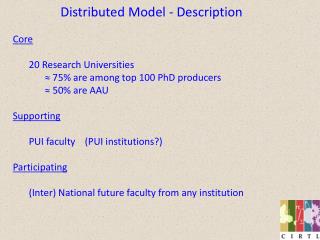
Distributed Model - Description • Core • 20 Research Universities • ≈ 75% are among top 100 PhD producers • ≈ 50% are AAU • Supporting • PUI faculty (PUI institutions?) • Participating • (Inter) National future faculty from any institution
Distributed Model - Description Outcomes Cross-Network CIRTL Scholars STEMES CIRTL Exchange Program Multiple Courses TAR Collaborations CIRTL Practitioners High High CIRTL Fellows Courses and ? Medium Medium CIRTL Casts Low Dosage Low Dosage Campus 1 Campus 2
Distributed Model - Description PARTICIPANTS (annual) CIRTL @ U 20 x 20 students >= 400 (current 15+ hours/semester) 20 x 15 stdnts = 300 (capacity based on in-kind) PUI instructors R1 future faculty N as available from above
Distributed Model – Network Management Board of Directors (Graduate Dean or reps, grad stdnt) (Executive Committee) Graduate Student Board Executive Director CIRTL Central COOs (Network Institutional Leaders) Operations Committees (Cross-Network Programs) Operations Committees (Evaluation) Operations Committees (National Presence) NB: Leadership roles and funding could flow to current Network institutions through Ops Comms
Distributed Model – Business Plan • Assumptions • Need $400K/yr for central operations - 3 FTE plus • cross-Network operating costs • Cross-Network activities increase from current, perhaps • scaling by institution • Institutions have four years to institutionalize • The cost challenge is not the Network, it is start-up for the local • CIRTL learning communities
Distributed Model – Business Plan • Revenue Streams • 15 universities x 4 years x $100K/yr => $6M => $7.5M NSF TUES grnt • 20 universities x $20K/yr => $400K/yr for core operations • In-Kind Streams • 20 universities x 1 fac-staff/yr => 20 Network activities/yr • N PUI faculty
Distributed Model - Description PARTICIPANTS (annual) CIRTL @ U 20 x 20 stdnts = 400 (current 15+ hours/semester) 20 x 15 stdnts = 300 (capacity based on in-kind) PUI instructors future faculty N as available from above