Understanding Mechanical Advantage and Simple Machines
This article explores the essential roles of simple machines in our daily lives. It explains how machines help us work more efficiently by transferring force, multiplying effort, magnifying speed and distance, and changing the direction of force. The concept of mechanical advantage is introduced, differentiating between Ideal Mechanical Advantage (IMA) and Actual Mechanical Advantage (AMA). The three classes of levers are discussed with examples, illustrating how each class affects force and movement. Practical applications and calculations of mechanical advantage are also provided for deeper understanding.

Understanding Mechanical Advantage and Simple Machines
E N D
Presentation Transcript
Mechanical Advantage What do simple machines do for us anyway?
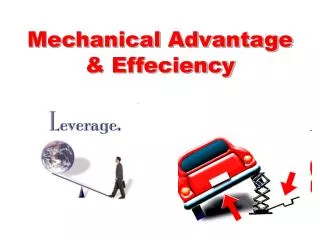
There are four ways that a machine helps us to do work. • Transfers our effort force from one place to another. Ex: seesaw • Multiply your effort force. Ex: crowbar • Magnify speed and distance. Ex: baseball bat • Changing the direction of the force. Ex: pulley on the flagpole
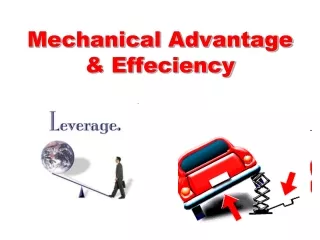
Mechanical Advantage • The number of times a machine multiplies your effort force. • Example: If you push on the handle of a car jack with a force of 30 lbs and the jack lifts a 3000 lb car, what is the jack’s mechanical advantage? • The jack multiplies your effort force by 100 times.
IMA – Ideal mechanical advantage. This is the number of times a machine is designed to multiply your effort force. It is based on measurements of the machine. Ignores friction AMA – Actual mechanical advantage This is the number of times the machine actually multiplies your effort force. AMA = resistance force/effort force. Includes the effects of friction There are 2 types of mechanical advantage. IMA is always larger than AMA.
There are 3 Classes of Levers • Depends on the location of 3 items: 1. Fulcrum – fixed point on a lever 2. Effort Arm – the part of the lever that exerts the effort force. 3. Resistance Arm – the part of the lever that exerts the resistance force. EA RA
1st Class Lever • Changes the direction of the force • Multiplies effort force • Magnifies speed and distance • Ex: seesaw, crowbar, scissors
2nd Class Lever • Multiply effort force • Mechanical advantage is always greater than 1. • Ex: bottle opener, boat oars, wheel barrow
3rd Class Lever • Magnifies speed and distance • Mechanical Advantage always less than 1 • Ex: baseball bat, golf club, broom, shovel
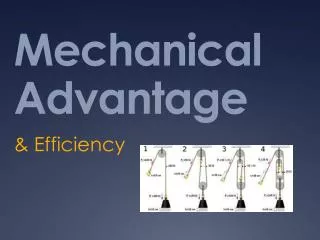
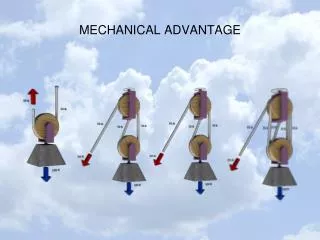
1. What is the IMA of this pulley system?2. Ignoring friction, if you want to lift the resistance 3 meters what will the effort distance be?3. Ignoring friction how much effort force will be necessary to lift a load of 15 newtons?4. How much work is done?