Understanding Heat Transfer and Temperature Changes in Different Substances
230 likes | 358 Vues
Heat is defined as the energy transferred due to a temperature difference, and it relates to both microscopic translational and rotational kinetic energy in an object. In scenarios involving mixing substances of different temperatures, the final temperature depends on mass and specific heat capacity, leading to concepts like latent heat of fusion and vaporization. This explores practical examples, such as pouring hot water into cold water or mixing ice with boiling water, illustrating principles of thermodynamics and energy transfer in physics.


Understanding Heat Transfer and Temperature Changes in Different Substances
E N D
Presentation Transcript
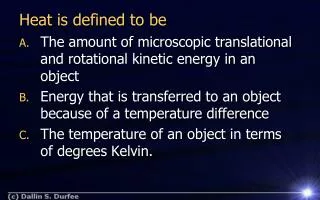
Heat is defined to be • The amount of microscopic translational and rotational kinetic energy in an object • Energy that is transferred to an object because of a temperature difference • The temperature of an object in terms of degrees Kelvin.
200 g of water at 100o is poured into 200 g of water at 0o. The resulting temperature will settle down to be • 0o • 50o • 100o • Greater than 50o but less than 100o • Less than 50o but more than 0o
cwater=4186 J/kg oCcgold=129 J/kg oCI use a heating element to put heat into a kg of water and a kg of gold at the same rate. Which changes temperature faster? • 1 kg water • 1 kg gold • They both heat up at the same rate. Q is energy transferred
Put 100g Al at 100o C into 500g water at 20o C. What is the final T?What will the final T be? • 100o • 97o • 20o • 23o • 60o cAl= 900 J/kg oC cH2O = 4186 J/kg oC
You put 0.4 kg of lead into a bucket containing 1.2 kg of pure acetone. Why in the world did you do that?
Idolatry (Even non-believers find something to believe in) "As I study ancient scripture, I am more and more convinced that there is significance in the fact that the commandment 'Thou shalt have no other gods before me' is the first of the Ten Commandments." - President Spencer W. Kimball (Aug 1977 Ensign)
It also takes energy to melt a solid or turn a liquid into gas Latent heat of fusion vs. vaporization
You place equal weights of ice (at 0o C) and boiling water (at 100o C) into a well-insulated container. What is the final temperature. • 0o C • Between 0oand 50o C • 50o C • Between 50o Cand 100o C Lf 3.33x10⁵ J/kg Lv 2.26x10⁶ J/kg c ice 2090 J/kg·oC water 4186 J/kg·oC steam 2010 J/kg·oC
You place a mass mi at temperature Ti into a mass mw of water at temperature Tw. What will be the final temperature, and how much ice will there be?
You place equal weights of ice (at -20o C) and water (at 0o C) into a well-insulated container. How much boiling water must be added to produce only water at 0o C.
Lf 3.33x10⁵ J/kg Lv 2.26x10⁶ J/kg c ice 2090 J/kg·oC water 4186 J/kg·oC steam 2010 J/kg·oC