Understanding Absolutism and Key Events in Central and Eastern Europe Before 1740
Explore the pivotal moments of absolutism in Central and Eastern Europe leading up to 1740. This chapter highlights significant events, including the phases of the Thirty Years' War and the notable military powers of the period, such as the Ottoman Empire and the best army in Europe. Key figures and their contributions, like the "Soldiers' King," Frederick William I, are discussed, alongside the cultural and linguistic diversity present in Eastern Europe. Gain insights into the challenges faced by urban residents due to warfare and the structure of nobility within different regions.

Understanding Absolutism and Key Events in Central and Eastern Europe Before 1740
E N D
Presentation Transcript
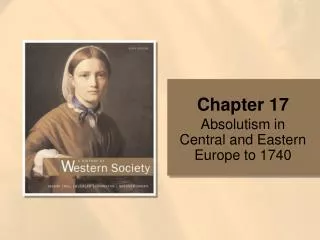
Chapter 17 Absolutism inCentral and Eastern Europe to 1740
Question • Which of the following was NOT one of the phases of the Thirty Years’ War? • Danish • French • Bohemian • Austrian
Answer • Which of the following was NOT one of the phases of the Thirty Years’ War? • Danish • French • Bohemian • Austrian (correct) Hint: See page 562.
Question • Which of the following was the name of theMongol Army? • Mongol Yoke • Cossacks • Golden Horde • Volga Union
Answer • Which of the following was the name of theMongol Army? • Mongol Yoke • Cossacks • Golden Horde (correct) • Volga Union Hint: See page 572.
Question • The best army in Europe belonged to • Austria. • Prussia. • Hungary. • Russia.
Answer • The best army in Europe belonged to • Austria. • Prussia. (correct) • Hungary. • Russia. Hint: See page 571.
Question • In the Ottoman Empire, the sultan’s army was called the • Junkers. • janissary corps. • Topkapi. • millet system.
Answer • In the Ottoman Empire, the sultan’s army was called the • Junkers. • janissary corps. (correct) • Topkapi. • millet system. Hint: See page 582.
Question • As a result of the Thirty Years’ War, perhaps ________ of the urban residents of centralEurope died. • one-half • two-fifths • three-fourths • one-third
Answer • As a result of the Thirty Years’ War, perhaps ________ of the urban residents of centralEurope died. • one-half • two-fifths • three-fourths • one-third (correct) Hint: See page 563.
Question • The Ottoman Empire was an explicitly ________ state. • Islamic • Catholic • Protestant • Jewish
Answer • The Ottoman Empire was an explicitly ________ state. • Islamic (correct) • Catholic • Protestant • Jewish Hint: See page 584.
Question • Which of the following rulers was known as “the Soldiers’ King”? • Peter the Great • Frederick William I • Ivan IV • Frederick III
Answer • Which of the following rulers was known as “the Soldiers’ King”? • Peter the Great • Frederick William I (correct) • Ivan IV • Frederick III Hint: See page 571.
Question • Which of the following kingdoms did NOTspeak German? • Austria • Bohemia • Styria • Tryol
Answer • Which of the following kingdoms did NOTspeak German? • Austria • Bohemia (correct) • Styria • Tyrol Hint: See page 565.
Question • The noble landowners of Prussia were known as • boyars. • Junkers. • service nobility. • electors.
Answer • The noble landowners of Prussia were known as • boyars. • Junkers. (correct) • service nobility. • electors. Hint: See page 570.
Question • The Battle of Poltava marked a Russianvictory over • Sweden. • Turkey. • Prussia. • Austria.
Answer • The Battle of Poltava marked a Russianvictory over • Sweden. (correct) • Turkey. • Prussia. • Austria. Hint: See page 578.